
How often you should groom your dog depends almost entirely on their coat type, not their breed name. Curly and wool-coated dogs like poodles and cavoodles need a professional groom every six to eight weeks. Double-coated dogs like golden retrievers and border collies don’t need clipping at all, but benefit from a seasonal de-shedding treatment during their heavy shedding periods in spring and autumn. Wire-coated breeds like many terriers do best with hand-stripping every few months, and smooth short-coated dogs usually need nothing more than the occasional bath. Brushing at home, between professional visits, is where most of the real work happens.
The mistake people make is grooming on a calendar instead of grooming for the coat in front of them. Once you understand which of the four coat types your dog has, the schedule almost sets itself.
The four coat types and how often to groom each
Forget breed names for a second and look at the actual coat. Almost every dog falls into one of four broad categories, and each one has its own rhythm.
| Coat type | Example breeds | Professional groom | Brushing at home |
|---|---|---|---|
| Curly / wool | Poodle, cavoodle, groodle | Every 6–8 weeks | 3–4x per week |
| Double coat | Golden retriever, border collie, husky | Seasonal de-shed (spring/autumn) | 2–3x per week, daily when shedding |
| Wire | Many terriers, schnauzer | Hand-strip every 8–12 weeks | Weekly |
| Smooth / short | Staffy, beagle, kelpie | Bath as needed | Weekly wipe-down |
These coat types show up clearly in what Australian groomers actually photograph. Looking at the most commonly professionally groomed breeds across the 18,376 grooming photos on Groomably, the curly and wool-coated breeds dominate: poodle leads with 2,132 photos, followed by cavoodle at 1,164. These are the dogs in salon chairs most often, precisely because their coats grow continuously and need regular clipping or scissoring to stay healthy.
Curly and wool coats: the every-six-weeks crowd
Poodles, cavoodles (cavapoos in the US), groodles (goldendoodles) and similar curly breeds have hair that grows continuously, much like ours. It doesn’t shed out the way other coats do, so it keeps getting longer and, left alone, matts.
These dogs need a professional groom every six to eight weeks, no real way around it. Just as important is the brushing in between. A curly coat can look fine on the surface while quietly felting into a solid mat down near the skin. You need to brush and then comb right to the skin three or four times a week to catch it. If a comb won’t glide through to the skin, you’ve got the start of a mat.
Double coats: brush, don’t shave
Double-coated breeds, golden retrievers, border collies, huskies, German shepherds, have a soft insulating undercoat beneath a coarser outer coat. They shed that undercoat heavily, usually twice a year in spring and autumn, in what’s affectionately known as “blowing coat”.
The right move for these dogs is a de-shedding treatment, where a groomer washes, blasts and brushes out the loose undercoat, not a clip. This is borne out in the data: golden retriever photos on Groomably are overwhelmingly bath-and-dry (123 photos) and de-shedding (14), with barely any showing a shaved or clipped coat (just 8 teddy-style). That’s no accident. Groomers don’t clip double coats, because the double coat does an important job, which we’ll come back to in a moment.
At home, brush a double coat two or three times a week year-round, and step that up to daily during a shedding season. An undercoat rake or a slicker brush makes a huge difference.
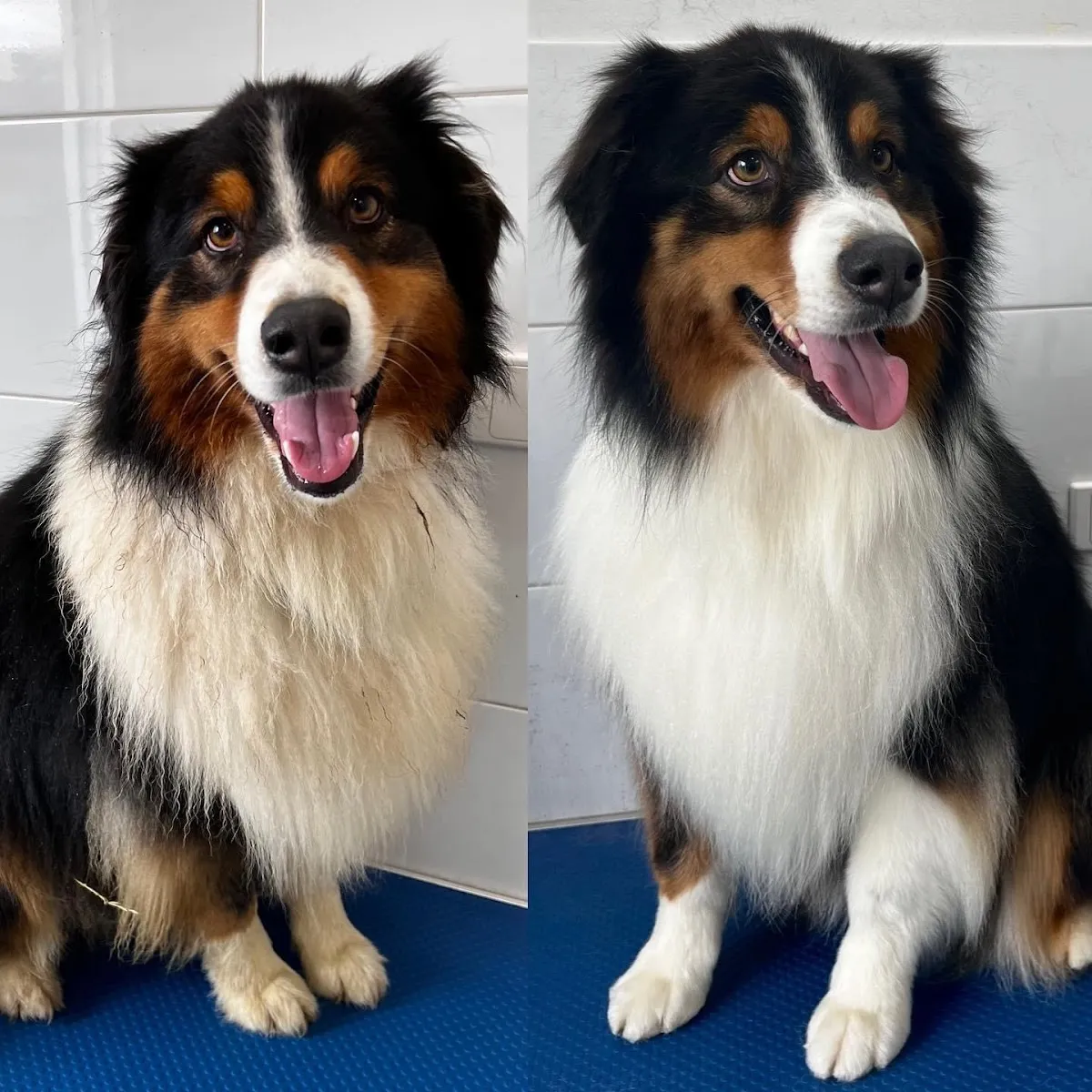 Photo: Dashing Designer Dogs, Mornington VIC — via Groomably
If you’ve got a heavy shedder, the de-shedding style page shows what the treatment actually looks like and what to ask for. De-shedding appeared in 407 photos across the directory, making it one of the more common services groomers offer.
Wire coats: hand-stripping over clipping
Wire-coated breeds, many terriers and the schnauzer family, have a harsh, bristly outer coat. The traditional and coat-friendly approach is hand-stripping, where dead hairs are plucked out by hand or with a stripping tool to make way for new growth. Done every eight to twelve weeks, it keeps the wiry texture and the proper colour.
Clipping a wire coat is faster and cheaper, and plenty of pet owners go that route, but over time it softens the coat and can dull the colour. Not every groomer offers hand-stripping, so if you want it, ask when you book. A weekly brush keeps things tidy in between.
Smooth and short coats: the low-maintenance lot
Staffies, beagles, kelpies, boxers and similar short smooth-coated dogs are the easy ones. They don’t need clipping, and they don’t need styling. A bath when they get smelly or muddy and a quick weekly wipe-down or rubber-curry brush to lift loose hair is genuinely all most of them require.
That doesn’t mean you can ignore them entirely. Nails still grow, ears still need checking, and a bath every few weeks keeps the skin healthy. But you’re not on a six-week clock the way the curly breeds are.
Don’t skip nails, ears and the bits in between
Whatever the coat, a few things apply to every dog. Nails should be trimmed roughly every three to four weeks; if you can hear them clicking on the floorboards, they’re too long. Ears need a regular check and clean, particularly in floppy-eared and curly breeds where moisture gets trapped. And a bath every four to six weeks suits most dogs, more often if they’re outdoorsy, less if they have sensitive skin.
A nail trim on its own usually costs $10 to $20, so it’s a cheap thing to keep on top of, and it stops the longer-term joint and posture problems that overgrown nails can cause.
Signs you’ve left it too long
Your dog will tell you when the schedule has slipped. Watch for matts you can’t easily comb through, especially behind the ears, under the legs and around the collar, a coat that smells even after a bath, scratching or licking at one spot, or a comb that simply won’t reach the skin. Any of these means it’s time to book.
If a coat is badly matted, be prepared for the groomer to clip it short rather than brush it out. Brushing out a tight mat is painful for the dog and isn’t something a responsible groomer will put them through. The kindest fix at that point is to clip and start fresh. It’s not the groomer being lazy, it’s them being humane.
Find the right groomer for your dog’s coat
The simplest rule: match the routine to the coat type, keep up the brushing between visits, and book before the matts arrive rather than after. If you’re not sure which coat type your dog has or what service they need, the full directory of listings lets you find groomers near you, and you can ask any of them directly. Most are happy to tell you over the phone how often a dog like yours should come in. A good groomer would much rather see your dog regularly than rescue a neglected coat once or twice a year.


