
The border collie is the most photographed working breed in Groomably’s library. We hold 554 border collie photos from Australian salons, 109 of which carry a grooming-style tag — more tagged photos than we have for the golden retriever, the labrador or the schnauzer.
That volume lets us answer a question the breed forums argue about endlessly with something better than opinion: what do Australian groomers actually do to a border collie?
The answer, in one line: they wash it and they de-shed it. Bath-and-dry and de-shedding together account for 67 of the 109 tagged photos. Clipped styles — teddy bear, puppy cut, scissor cut — account for 16.
Sixteen is not zero, and that is the interesting part of this guide.
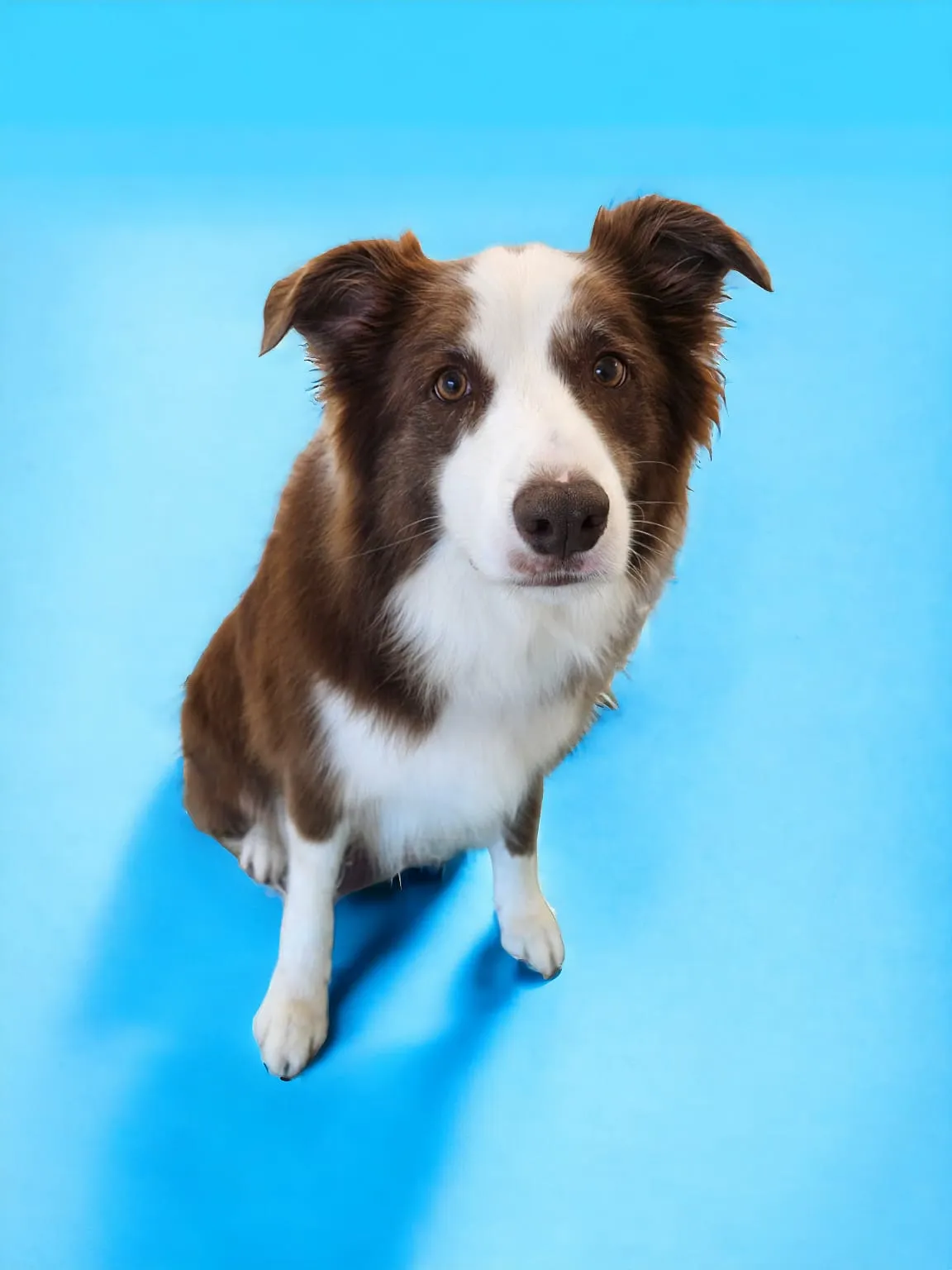 Photo: Dinkie Deluxe, Kalinga QLD — via Groomably
The border collie coat, and why it varies so much
Border collies come in two coat lengths, and owners are often unsure which they have.
The rough coat is the classic one: a medium-to-long outer coat with obvious feathering on the back of the legs, a full ruff around the neck and chest, and a plumed tail. It looks longer than it is because of the feathering.
The smooth coat is shorter and flatter all over, with minimal feathering. It is the same breed, the same double coat, the same shedding — just a shorter guard layer.
Both have a dense undercoat, and that undercoat is the whole grooming story. Guard hairs on top do the weatherproofing; the woolly undercoat underneath does the insulating and is what the dog sheds. Border collies shed steadily year-round and drop coat heavily twice a year.
A working breed’s coat is also genuinely functional. Border collies were bred to work all day in Scottish and Northumbrian weather, and the coat is a piece of equipment: rain runs off the guard hairs, the undercoat keeps a stable temperature underneath, and grass seeds and burrs mostly stay out of the skin. That matters when you get to the clipping question.
What Australian salons actually do — the numbers
Of the 109 style-tagged border collie photos in the library:
| Service | Photos | Share |
|---|---|---|
| Bath and dry | 40 | 37% |
| De-shedding treatment | 27 | 25% |
| Full groom | 18 | 17% |
| Nail trimming | 17 | 16% |
| Breed-specific trim (tidy) | 13 | 12% |
| Teddy bear cut | 9 | 8% |
| Creative grooming | 5 | 5% |
| Puppy cut | 5 | 5% |
| Scissor cut | 2 | 2% |
Photos can carry more than one tag, so the column sums above 109.
De-shedding at 24.8% is the headline. Across the whole library, de-shedding accounts for just 8.5% of style-tagged photos. The border collie runs at roughly three times that rate — fourth-highest of any breed we hold, behind the husky (52.1%), the samoyed (49.0%) and the German shepherd (33.3%).
The other thing worth noticing is what is not there. The teddy bear cut is the most common groom in Australia at 38.6% of all tagged photos in the library. On border collies it is 8%. This is a breed that mostly gets washed, dried and de-shed, and mostly keeps its own outline.
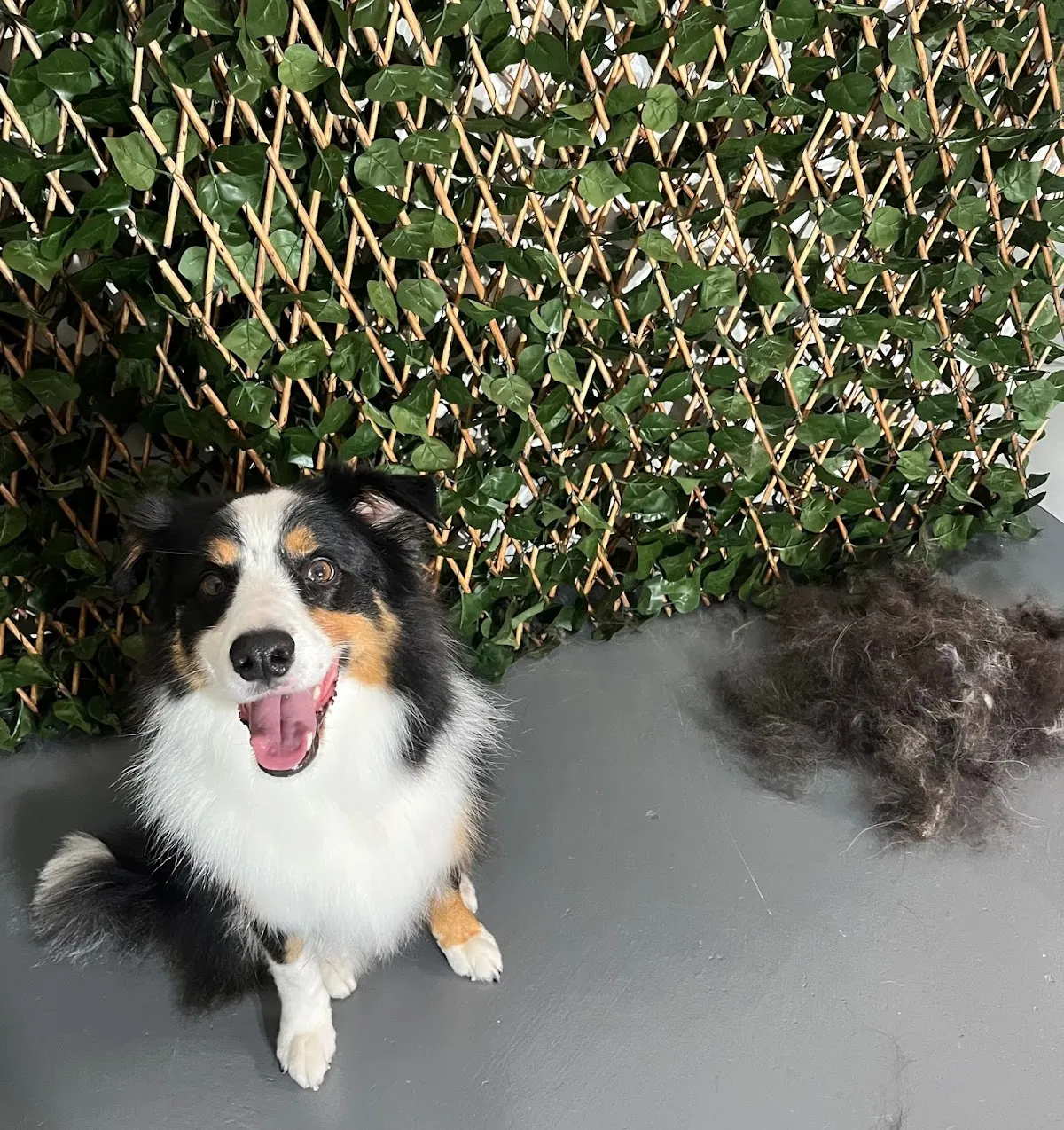 A quarter of every tagged border collie groom in our library is a de-shed. Photo: Gold Coast Paw on Leash, Carrara QLD — via Groomably
What a de-shed actually involves
Not a tool — a sequence. The groomer bathes the dog in a shampoo and conditioner chosen to loosen and hydrate the undercoat, then uses a high-velocity dryer to blast air right down to the skin. That air is what drives loose undercoat out, in clouds. An undercoat rake and slicker then collect what the dryer has released, and the feathering gets combed through.
There is no home equivalent of the high-velocity dryer, which is why two or three professional de-sheds a year timed to the coat blows outperform months of casual brushing. You can find salons offering it on our de-shedding page.
The clipping question — and the 16 that were clipped
Here is where we can be more honest than most breed guides, because we can count.
Sixteen border collies in our library were clipped down — nine into a teddy bear cut, five into a puppy cut, two scissor cut. That is 15% of the tagged photos. Border collie owners are told online, forcefully, that you must never clip one. Australian salons clip them occasionally anyway.
Both things can be true. Here is the actual trade-off.
The case against clipping is the same as for any double coat. Undercoat regrows faster than guard coat, so a clipped border collie often grows back woolly, duller, and patchier in texture. Repeatedly clipped dogs can develop lasting coat change — the trade calls it clipper alopecia. You also remove the layer that was blocking UV and keeping grass seeds off the skin, and you do not reduce shedding, because the undercoat is still there and still dropping, now in short prickly fragments. For a dog that will be outdoors in an Australian summer, that is a real cost.
When groomers do it anyway, in our experience of the data, it is usually one of these:
- Matting that has gone past brushing. A neglected rough coat can felt behind the ears, in the armpits and under the tail. Clipping a pelted coat off is not a style choice, it is the humane option — the alternative is hours of painful dematting.
- Medical and hygiene reasons. Skin conditions needing topical treatment, incontinence in an older dog, or surgical recovery.
- Genuine welfare cases in extreme heat, usually in older or unwell dogs, and usually a partial clip rather than a full shave.
- Owner request, made knowingly. Some owners decide, having heard the trade-off, that they prefer the maintenance. That is their call to make.
What our data cannot tell us is why each of the 16 was clipped. We are not going to pretend otherwise. What it does show is that clipping a border collie is uncommon but not unheard of, and that the sensible framing is a trade-off with real costs, not an absolute prohibition.
Our longer treatment of this is at should you shave a double-coated dog.
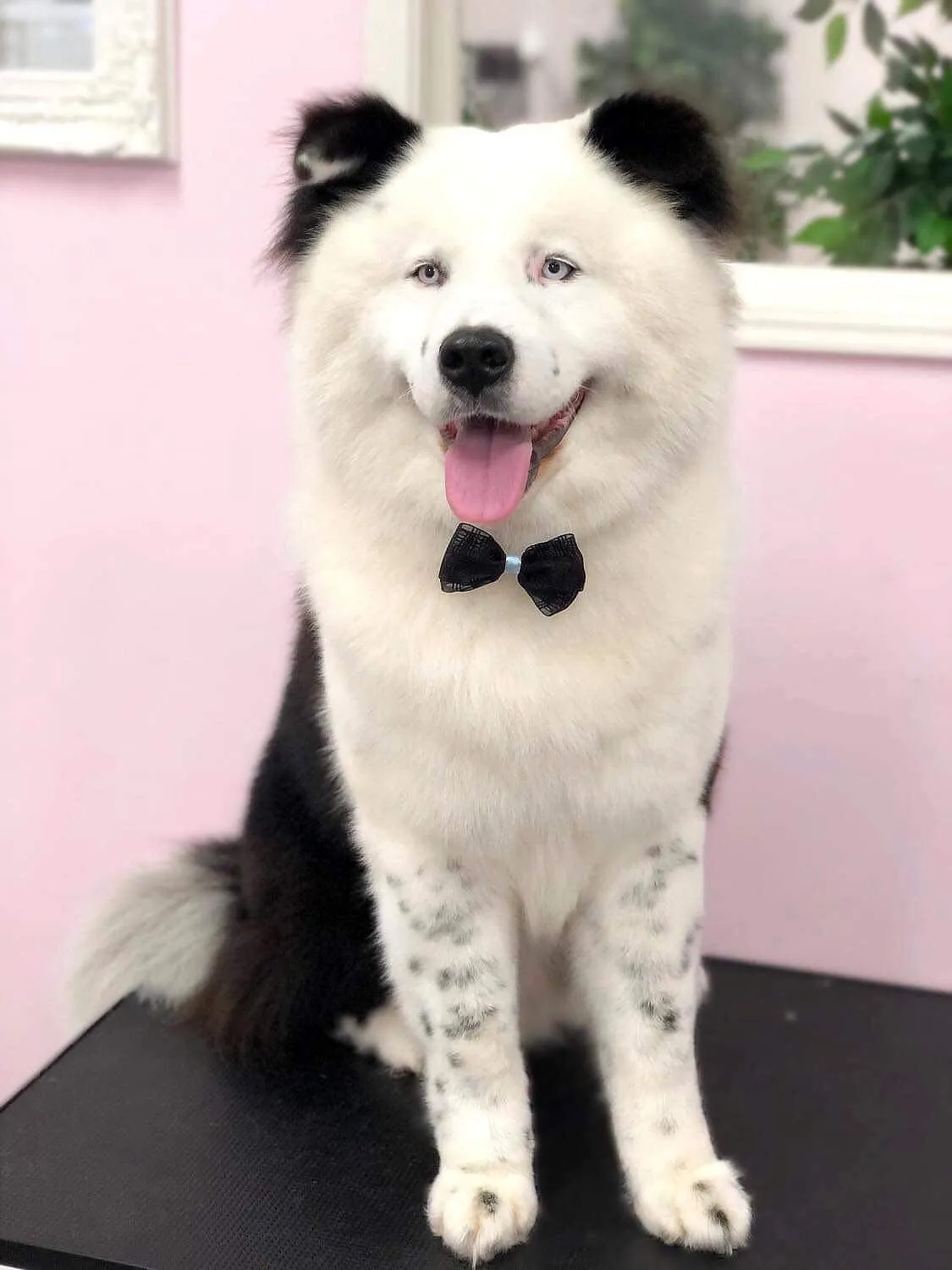 One of the nine teddy bear cuts in our border collie set. Uncommon, and a genuine trade-off. Photo: Pooch Avenue, Slacks Creek QLD — via Groomably
The tidy — what a border collie groom looks like when it goes well
The 13 photos tagged breed-specific show what most owners actually want, and it is worth naming precisely so you can ask for it.
A border collie tidy leaves the body coat alone entirely and neatens the edges:
- Feet. Hair between the pads trimmed flush — this is a safety trim, not cosmetic. Pad hair collects grass seeds, mats into painful clumps and makes tiles and floorboards slippery for a dog that likes to turn hard.
- Hocks. The feathering down the back of the hind legs scissored to a clean line.
- Sanitary trim. Neatening around the rear and belly.
- Ears. The fringe behind and below the ears thinned or tidied — this is the number one matting site on the breed.
- Tail. The plume shaped to a tidy outline, not shortened.
Nothing on the back, sides or ruff is clipped. The dog still looks like a border collie; it just looks like a well-kept one. If you want this, ask for “a bath, blow-out, de-shed and a tidy on feet, hocks and sanitary” — that sentence gets you exactly the right groom in any salon in the country.
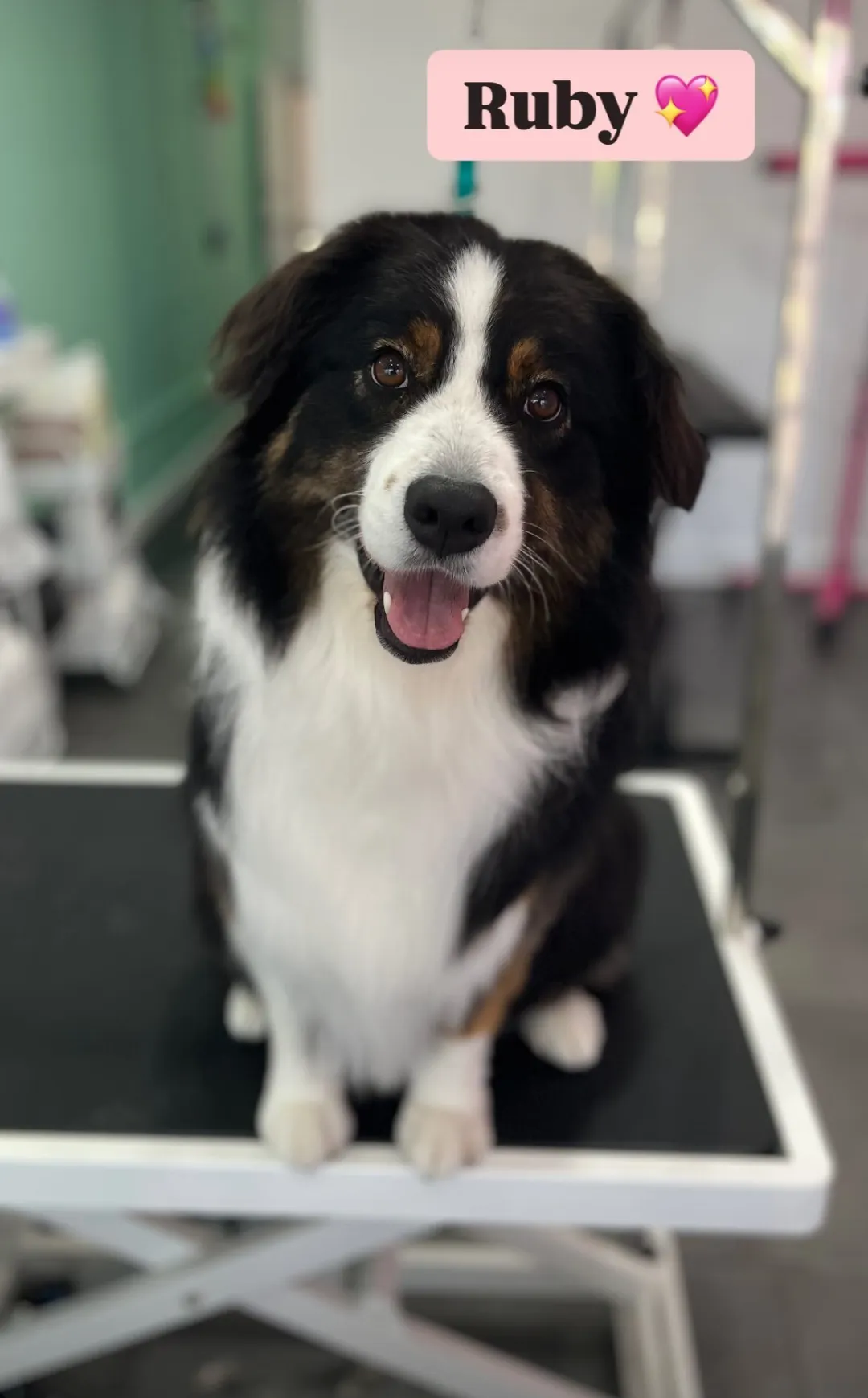 Photo: Stitch and Grizz Dog Grooming, Coniston NSW — via Groomably
How often does a border collie need grooming?
Professionally:
- Twice a year, minimum, timed to the spring and autumn coat blows. These are the appointments that pay for themselves.
- Every 8–12 weeks is the comfortable routine for most pet border collies — bath, blow-out, de-shed, tidy.
- Every 4–6 weeks for dogs that work, swim, live outdoors, or have heavy feathering that mats.
At home: brush twice a week normally, daily during a coat blow. Use an undercoat rake for the body and a slicker plus a steel comb for the feathering behind the ears, on the trousers and under the tail. The comb is the tool that matters — a slicker glides over the top of a forming mat and leaves it there; a steel comb finds it.
Check behind the ears every week without exception. It is where border collie mats start, and it is the area owners consistently miss.
Nails every 4–6 weeks. A border collie that turns and stops hard on hard surfaces needs correct nail length more than most breeds. See nail trimming.
Grass seeds — the Australian problem
This deserves its own note, because it is more serious here than in the breed’s home climate.
From late spring through summer, grass seeds work into feathering, between toes, into ears and armpits. Once in, they migrate — they are barbed and only move one direction, through skin, and can end up requiring surgery to remove.
A rough-coated border collie exercised in long dry grass should be checked after every walk in seed season: between the toes and pads, in the armpits, in the ear fringes, and along the belly and groin. Keeping the foot and pad hair short through summer is the single most effective preventive trim there is, and it is a good reason to keep a border collie’s salon interval tighter over the warmer months.
Frequently asked questions
Do border collies shed a lot? Yes — steadily all year, and heavily twice a year. In our library de-shedding is 24.8% of tagged border collie grooms against a library baseline of 8.5%, which is the data version of what every owner already knows.
Should I shave my border collie in summer? Generally no. The undercoat is insulation in both directions and stays behind anyway; the guard coat you remove was providing sun protection. A de-shed removes the insulating layer, which is what you actually want gone. There are real exceptions — severe matting, medical need, welfare cases in extreme heat — and 16 dogs in our library were clipped for reasons like those.
Smooth-coat vs rough-coat — is the grooming different? Same coat biology, same shedding, same de-shedding need. The rough coat adds feathering, so it adds matting risk and needs combing behind the ears and on the trousers. Smooth coats are lower maintenance but shed just as much.
Why is my border collie’s coat matting behind the ears? That fringe is fine, dense and rubs constantly against the ear. It is the first place to felt on almost every rough-coated border collie. Comb it through weekly with a steel comb — a slicker alone will skate over the top of a mat.
How much does border collie grooming cost? It is priced as a medium-to-large bath and de-shed rather than a haircut, and it varies with how much coat is coming out. See our dog grooming cost guide.
Find a border collie groomer
Browse salons with real border collie work in their galleries on our border collie page, or search the full directory by suburb. Every photo above is a real Australian dog at a real salon, credited to the business that groomed it.


