
Most breed grooming guides tell you what you could do to a coat. This one starts with what Australian groomers actually do, because on this breed the two are very far apart.
Groomably’s classified library holds 232 photos of German shepherds taken in Australian salons. Forty-two of them carry a grooming-style tag. Here is the number that matters: not one of those 232 photos shows a clipped German shepherd. No teddy bear cut, no puppy cut, no scissor cut, no kennel cut — zero, across every salon in the library.
For context, the teddy bear cut is the single most photographed groom in Australia: 38.6% of every style-tagged photo we hold. It appears on cavoodles, poodles, shih tzus, maltese, even border collies. It does not appear on a German shepherd once.
That is not a coincidence, and it is not groomers being lazy. It is the whole story of this coat.
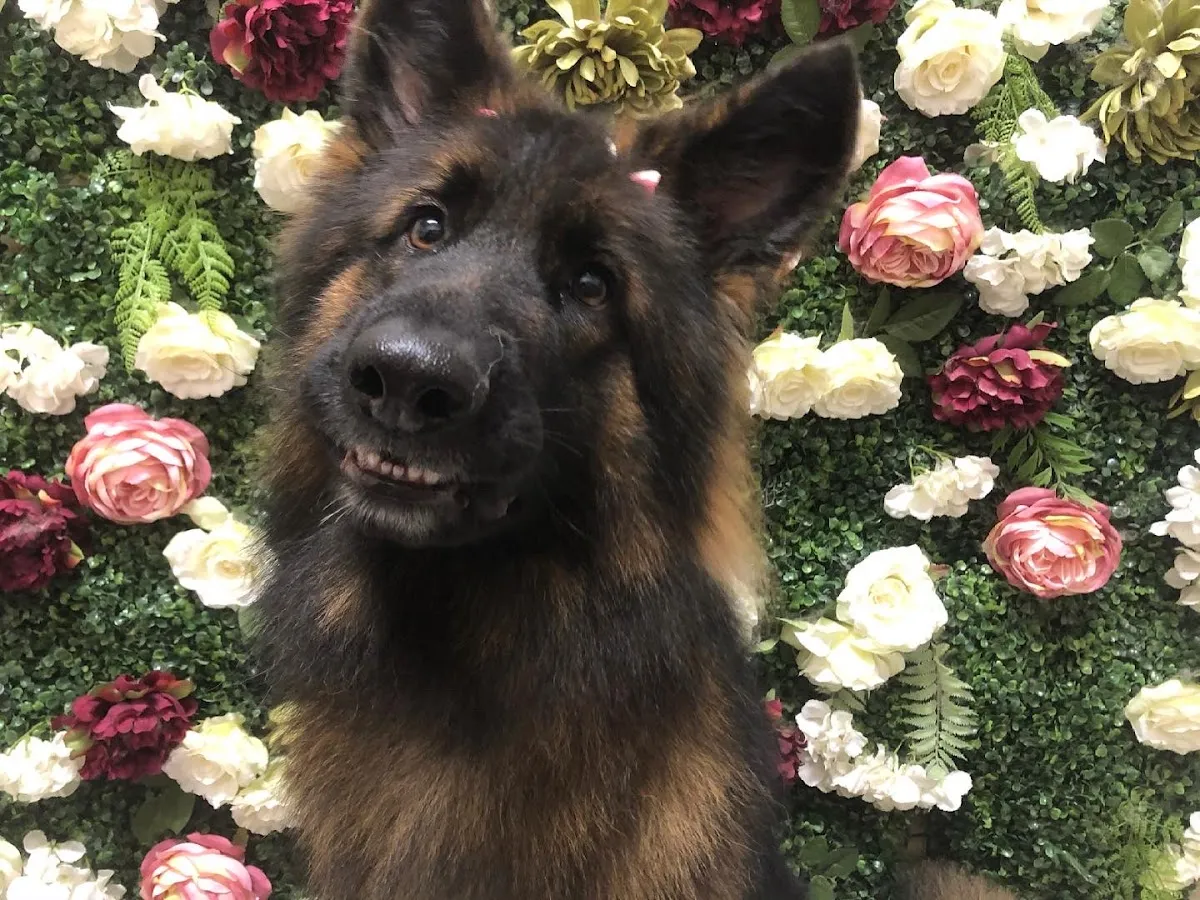 A finished German shepherd groom looks like a clean, brushed-out German shepherd — that is the point. Photo: Mima’s Grooming, Allenby Gardens SA — via Groomably
What a German shepherd coat actually is
A German shepherd has a double coat, and the two layers do completely different jobs.
The outer coat is made of guard hairs — coarse, straight, medium-length, slightly oily, and lying flat over the body. They shed water, block UV, and keep grass seeds and dirt away from the skin. Guard hairs grow to a determined length and stop.
The undercoat is the soft, dense, woolly layer underneath. It is the insulation, and it works in both directions — it traps warm air in winter and holds a layer of cooler air against the skin in summer. Unlike the guard coat, the undercoat is shed and regrown on a seasonal cycle.
This is why a German shepherd sheds the way it does. Owners describe it as “blowing coat,” and twice a year that is literally what happens: the dog drops most of its undercoat over a few weeks. In between, it sheds steadily all year. The phrase used in the grooming trade — “German shedder” — is affectionate and accurate.
The crucial point is that shedding is an undercoat problem, and clipping is an outer-coat solution. They do not meet. Running clippers over a German shepherd shortens the guard hairs, which were never the thing making the mess, and leaves the undercoat exactly where it was — still dense, still dropping, now with less airflow reaching it and no guard layer protecting the skin.
Why shaving a German shepherd is a mistake
Guard hairs and undercoat regrow at different rates, and the undercoat is faster. Shave a double coat and the woolly layer typically comes back in first, growing up through and around the slower guard hairs. The result is a coat that is patchy, duller in colour, texturally woolly rather than sleek, and worse at doing every job the original coat did.
On some double-coated dogs this recovers over a couple of coat cycles. On others — particularly older dogs, and particularly after repeated shaving — it does not fully recover at all. The trade calls the permanent version clipper alopecia or post-clipping coat change: bald or thin patches where the guard coat never returns properly.
The damage list is worth being blunt about:
- Sunburn and skin cancer risk. A shaved German shepherd has no UV barrier. Black and tan skin under a shaved coat burns.
- Worse heat regulation, not better. The undercoat is insulation in both directions. Removing the guard coat exposes skin to direct sun while leaving the insulating layer in place — the opposite of what an owner shaving for summer intends.
- No shedding benefit. The undercoat still sheds. It now sheds in shorter, prickly fragments that weave into fabric more stubbornly than full-length hair.
- Grass seeds and insect bites reach skin that used to be protected.
Our photo library is, in effect, 232 groomers independently agreeing with all of that.
If you want the longer version of this argument across every double-coated breed, we wrote it up separately: should you shave a double-coated dog.
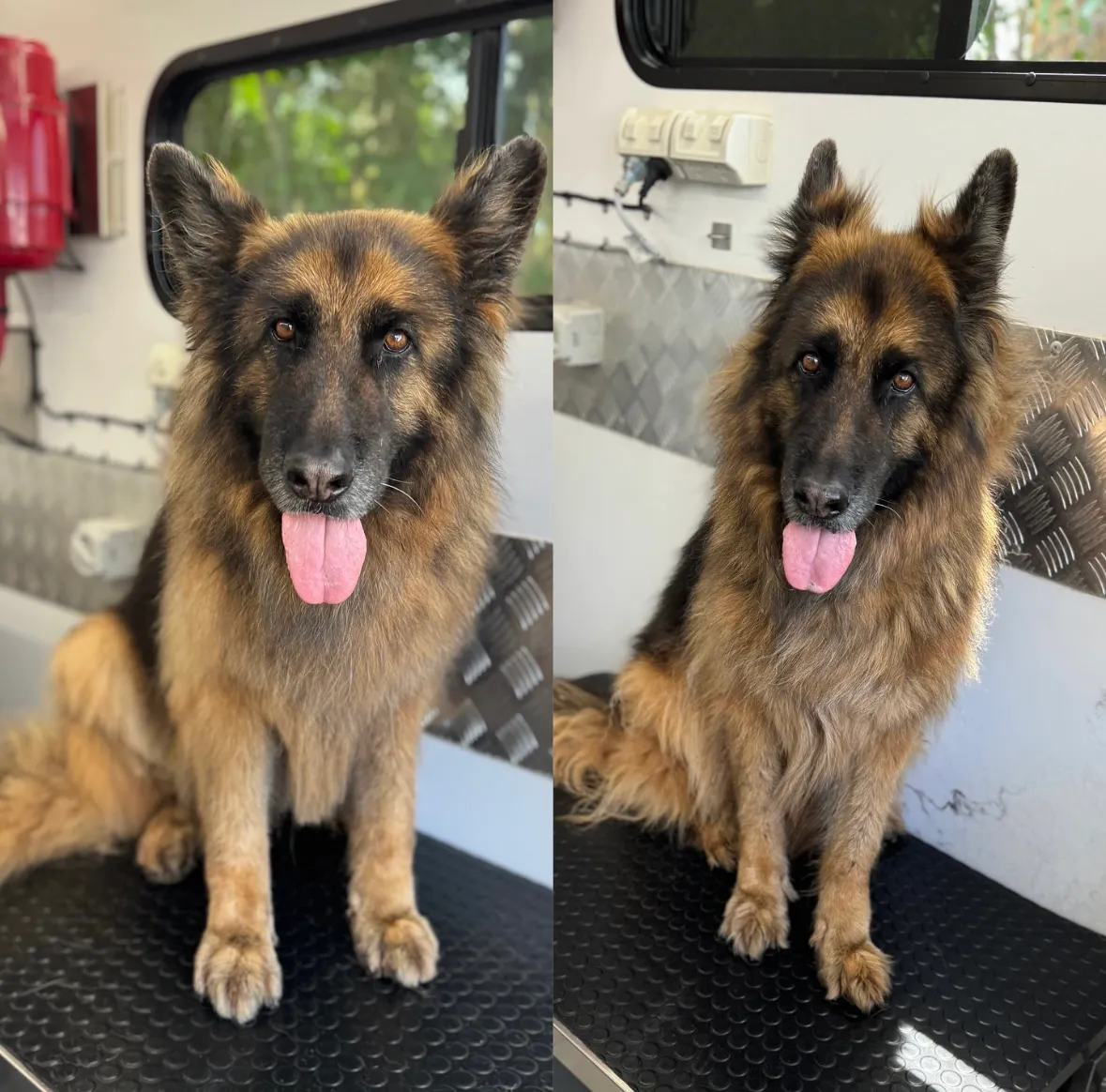 De-shedding, not clipping, is the German shepherd’s actual salon service. Photo: W.A.G.S Dog Grooming, Noosa Heads QLD — via Groomably
So what does a German shepherd groom involve?
If nobody is cutting the coat, what is the appointment for? Our style tags answer that directly. Of the 42 style-tagged German shepherd photos:
| Service | Photos | Share of tagged GSD photos |
|---|---|---|
| Bath and dry | 21 | 50% |
| De-shedding treatment | 14 | 33% |
| Full groom (bath, blow-out, tidy, nails) | 5 | 12% |
| Nail trimming | 5 | 12% |
| Anxious-pet handling | 1 | 2% |
| Senior-pet handling | 1 | 2% |
Photos can carry more than one tag, so the column sums above 42.
A German shepherd appointment is a bath, a serious blow-out, and a de-shed. That is the whole service. The dog goes in looking like a German shepherd and comes out looking like a cleaner German shepherd with dramatically less loose coat in it.
What a de-shedding treatment actually does
This is the service most owners under-book and then are astonished by.
A proper de-shed is a sequence, not a tool. The groomer bathes the dog with a shampoo and a conditioner chosen to loosen and hydrate the undercoat. Then — the part that does most of the work — a high-velocity dryer is used to blast air down to the skin, which physically drives loose undercoat out of the coat in clouds. Only then does the groomer work through with an undercoat rake and a slicker to collect what the dryer has released.
Done properly, a single de-shed removes an amount of coat most owners find genuinely shocking, and it cuts household shedding for weeks. It does it without a blade ever touching the guard coat.
Some salons list this as a de-shedding treatment or a “furminator” service and price it as an add-on to a bath. You can see which salons near you tag it as a service on our de-shedding page, and the same for a straightforward bath and dry.
The de-shedding gradient — where the German shepherd sits
Because every photo in our library is tagged by breed and by service, we can measure how “de-sheddy” a breed is: what share of its style-tagged photos are a de-shedding treatment. Across the entire library the baseline is 8.5%.
| Breed | De-shedding photos | Share of that breed’s tagged photos |
|---|---|---|
| Husky | 50 / 96 | 52.1% |
| Samoyed | 25 / 51 | 49.0% |
| German shepherd | 14 / 42 | 33.3% |
| Border collie | 27 / 109 | 24.8% |
| Dachshund | 7 / 46 | 15.2% |
| Golden retriever | 14 / 150 | 9.3% |
| Labrador | 5 / 54 | 9.3% |
| Shih tzu | 8 / 305 | 2.6% |
| Cavoodle | 7 / 325 | 2.2% |
| Poodle | 12 / 1,141 | 1.1% |
| Library baseline | 407 / 4,783 | 8.5% |
The German shepherd sits at roughly four times the library average — third of every breed we hold enough data on, behind only the two arctic coats. Read the other end of the table and the picture completes itself: the poodle, at 1.1%, barely sheds at all and is instead the most-clipped breed in the library. Coat type determines the service. Nothing else does.
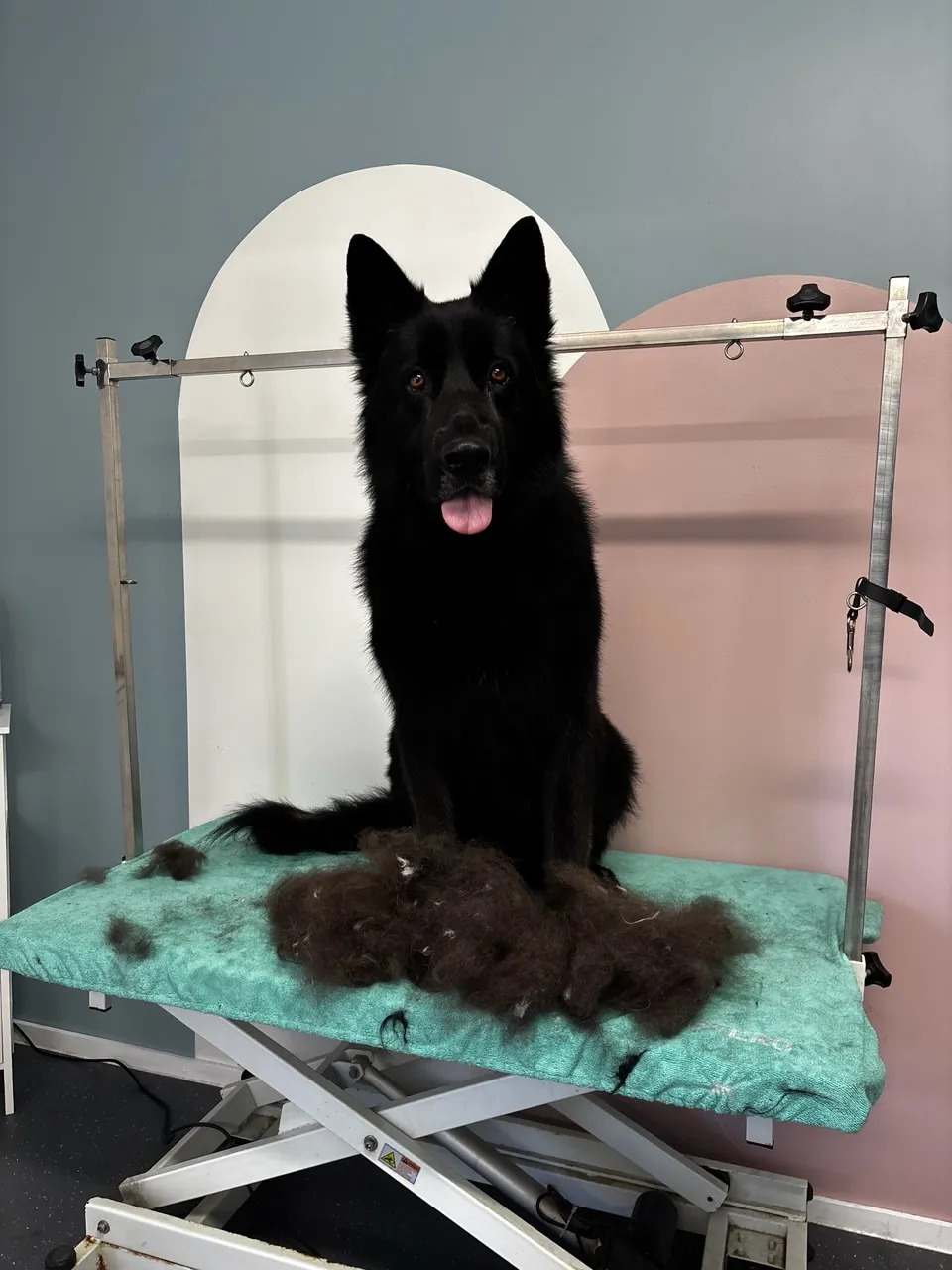 The pile beside the dog is the service. Photo: Coastal Pups Dog Grooming, Noosaville QLD — via Groomably
How often should a German shepherd see a groomer?
There is no haircut driving the schedule, so the interval is set by shedding and by how dirty the dog gets.
- Twice a year, minimum — booked around the coat blows. Late winter into spring, and again in autumn. These are the appointments that matter most; a de-shed timed to the start of a blow removes the bulk of it in one session instead of over six weeks of your carpet.
- Every 8–12 weeks is a comfortable routine for most family German shepherds — a bath, blow-out and de-shed, keeping the coat and skin in good order year-round.
- Every 4–6 weeks if the dog swims, works, lives outdoors, or has skin that needs managing.
Nails are the thing owners forget. A German shepherd is heavy enough that overgrown nails change how it loads its feet and hocks, which matters on a breed already prone to joint trouble. Most need a trim every 4–6 weeks — more often than they need a bath. Salons will do nails as a standalone visit; see nail trimming.
Our general guide to how often you should groom your dog covers the reasoning across coat types.
What you should be doing at home
Home brushing is what makes the salon interval workable.
The two tools that matter:
- An undercoat rake. Long, widely spaced rounded teeth that pass through the guard coat and pull loose undercoat out. This is the tool that does 80% of the work on this breed.
- A slicker brush for finishing, and for the softer coat behind the ears, in the “trousers” on the back legs, and around the tail base.
Frequency: once a week normally; daily during a coat blow, when ten minutes a day genuinely changes how much hair is in your house.
Technique: work in sections, always in the direction the coat lies, and go right down to the skin — the loose undercoat is at the bottom, not the top. Skimming the surface with a brush feels productive and removes almost nothing. Pay particular attention to the trousers, behind the ears, and the ruff, which mat first.
What not to do: do not bath a German shepherd frequently in the belief it reduces shedding. It does not, and stripping the coat’s oils makes the skin worse. Every 6–12 weeks is plenty unless the dog is actually dirty.
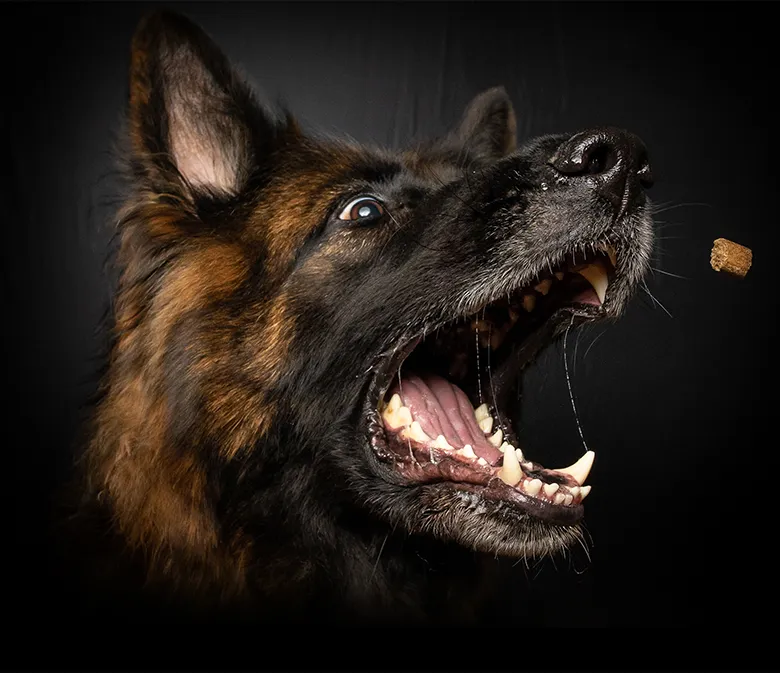 Photo: The Dog Shed, Bouvard WA — via Groomably
Long-coat German shepherds
A minority of German shepherds carry a recessive gene for a long coat — feathering on the ears, legs, tail and ruff, and a noticeably plusher outline. Some long-coats have a full undercoat; some have very little.
The rules do not change. A long-coat still is not clipped. What changes is that the feathering mats, particularly behind the ears, in the armpits, on the trousers and under the tail. Those areas need combing through weekly, and a groomer will scissor-tidy the feathering and the feet to keep it neat and free of grass seeds. That tidy is a scissor trim on furnishings — not a body clip.
Booking a German shepherd in: what to ask for
A large, powerful, sometimes wary dog is a genuine handling job, and not every salon takes them. Worth sorting out on the phone:
- Ask for “a bath, blow-out and de-shed” — that phrase tells a groomer exactly what you want. Do not ask for “a haircut” or “a summer cut”; a good groomer will talk you out of it and a less experienced one might not.
- Check they take large breeds and have a bath and a table rated for the weight. Not all mobile setups do.
- Say how your dog handles handling. Nervous, reactive, dislikes the dryer, dislikes strangers — say it upfront. Some salons offer quiet or one-dog-at-a-time appointments, which is what the anxious-pet tag in our data represents.
- Allow more time. A thorough de-shed on a shedding German shepherd is a two-to-three hour job. A salon quoting you forty-five minutes is not doing the drying properly.
- Expect to pay more than a small-dog groom. Size, coat volume and drying time all scale. Our dog grooming cost guide sets out the ranges Australian salons actually charge.
Frequently asked questions
Will shaving my German shepherd keep it cool in summer? No — it does the opposite. The undercoat is insulation in both directions and stays behind anyway; what you remove is the guard coat that was blocking the sun. A de-shed removes the insulating layer, which is the thing you actually wanted gone.
My groomer offered to shave my German shepherd. Should I let them? We would not, and neither would the 232 salons in our library. If a groomer suggests it unprompted on a healthy coat, get a second opinion. The exception is genuine medical need — severe matting that cannot be brushed out, a skin condition needing treatment, or surgical prep — where a vet or groomer will clip for a reason and both of you know what the trade-off is.
How much does German shepherd grooming cost in Australia? It is priced as a large-breed bath and de-shed rather than a haircut, and it varies by city and by how much coat is coming out. See our dog grooming cost guide for current ranges.
Do German shepherds need professional grooming at all? They can be maintained at home by a committed owner with an undercoat rake and a good routine. What a salon adds is the high-velocity dryer — there is no home equivalent, and it is the single most effective de-shedding tool there is. Most owners find two or three professional de-sheds a year, timed to the coat blows, do more than months of brushing.
When do German shepherds shed the most? Twice a year, typically late winter into spring and again in autumn, over roughly two to four weeks each time. Book the groomer at the start of a blow, not after it.
Find a groomer who takes German shepherds
Browse salons that list de-shedding and large-breed handling on our German shepherd page, or search every groomer in the directory by suburb. Every photo in this guide is a real dog groomed at a real Australian salon, linked to the business that groomed it.


