
Groomably holds 188 samoyed photos from 163 Australian salons. Fifty-one carry a grooming-style tag. That is a big enough set to say something specific, and the specific thing turns out to be more interesting than we expected.
Samoyeds and Siberian huskies are both Arctic spitz breeds with the same double-coat architecture, and the internet treats them as the same grooming problem. Our data says Australian groomers do not.
| Samoyed | Husky | |
|---|---|---|
| Photos in library | 188 | 241 |
| De-shedding (of tagged) | 49.0% | 52.1% |
| Any clipped or scissored style | 11.2% | 0.8% |
Both breeds get de-shed at roughly six times the library-wide rate. But one samoyed in nine in our library has been scissored, trimmed or styled in some way, against one husky in 120. That is a fourteen-fold difference between two breeds that supposedly groom identically.
This guide is about why.
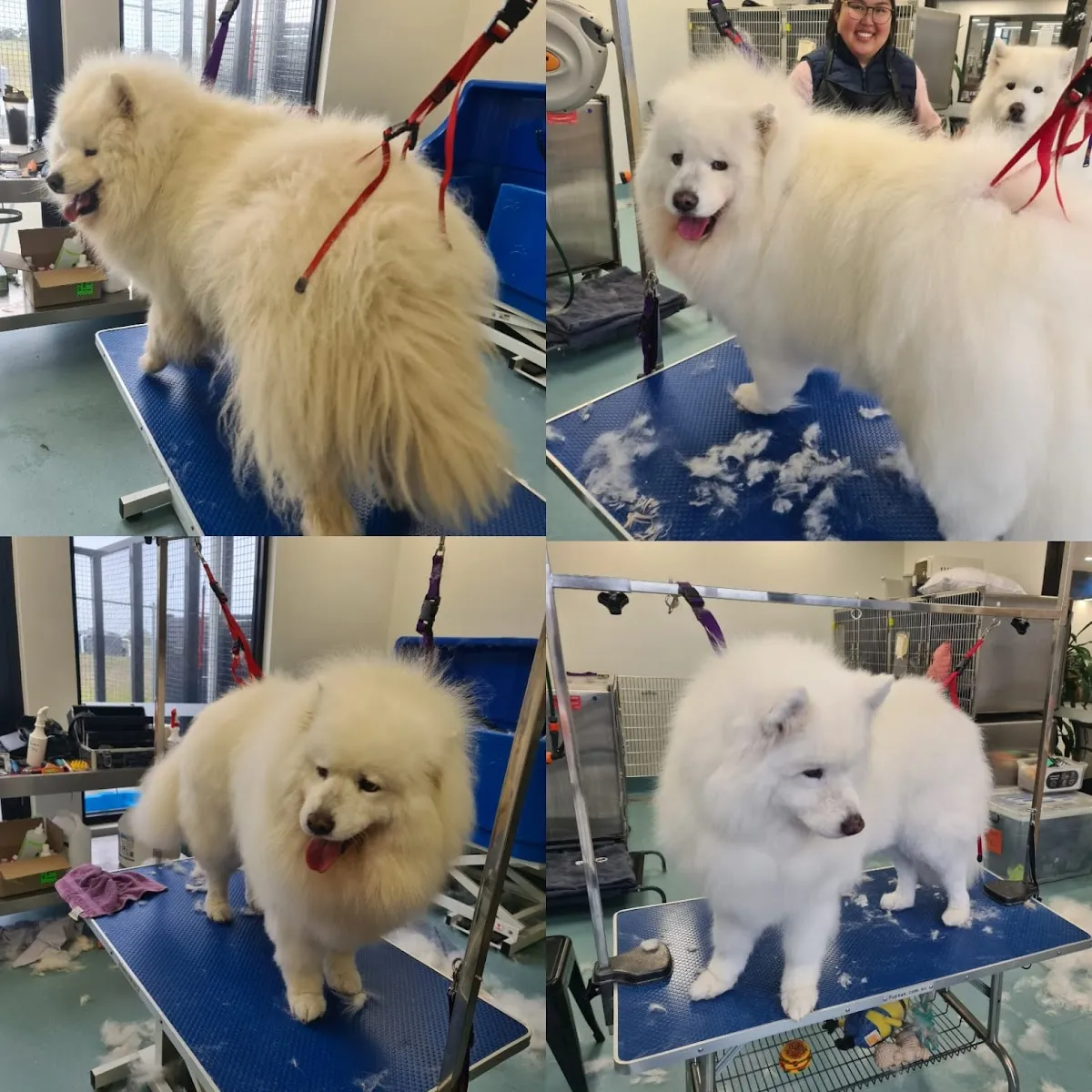 Photo: AAPS Grooming Keysborough, Keysborough VIC — via Groomably
What Australian salons actually do to a samoyed
Of the 51 style-tagged samoyed photos:
| Service | Photos | Share of tagged |
|---|---|---|
| De-shedding treatment | 25 | 49.0% |
| Bath and dry | 17 | 33.3% |
| Full groom | 12 | 23.5% |
| Teddy bear cut | 9 | 17.6% |
| Creative grooming | 3 | 5.9% |
| Puppy cut | 2 | 3.9% |
| Nail trimming | 2 | 3.9% |
| Puppy groom | 1 | 2.0% |
Photos can carry more than one tag, so the column sums above 51.
De-shedding at 49.0% against a library baseline of 8.5% is the expected headline, and it is the second-highest rate of any breed we hold, behind only the husky.
Full groom at 23.5% and teddy bear cut at 17.6% are the unexpected part. On a husky those two numbers are 1.0% and 1.0%.
The explanation is not that groomers are shaving samoyeds. It is that the samoyed coat does get worked with scissors in a way the husky coat does not — and understanding the difference will change what you ask for at the counter.
Why the samoyed coat is a different job
Both breeds carry a harsh guard coat over a dense woolly undercoat. Three things make the samoyed a scissoring breed anyway.
It is longer, and it stands off. The samoyed’s guard coat is longer than a husky’s and grows perpendicular to the body rather than lying flat — the “stand-off” coat that gives the breed its silhouette. A coat that stands away from the body has an outline, and an outline can be shaped. A husky’s flat-lying coat has no outline to work with.
It is white, and white shows everything. Samoyeds are white to biscuit, so grass stain, mud, urine marking on the trousers and tear staining around the eyes are all visible in a way they simply are not on an agouti husky. A great deal of samoyed salon time is bathing, whitening and neatening the areas that show — feet, trousers, sanitary, face fringe.
The furnishings mat. The dense feathering on the trousers, behind the ears, in the ruff and around the tail plume felts more readily than anything on a husky. Where a mat has formed past dematting, a groomer takes it out with scissors, and that photo lands in our data as a scissored dog.
None of this means the body coat gets clipped. It means the samoyed gets tidied, and the husky does not.
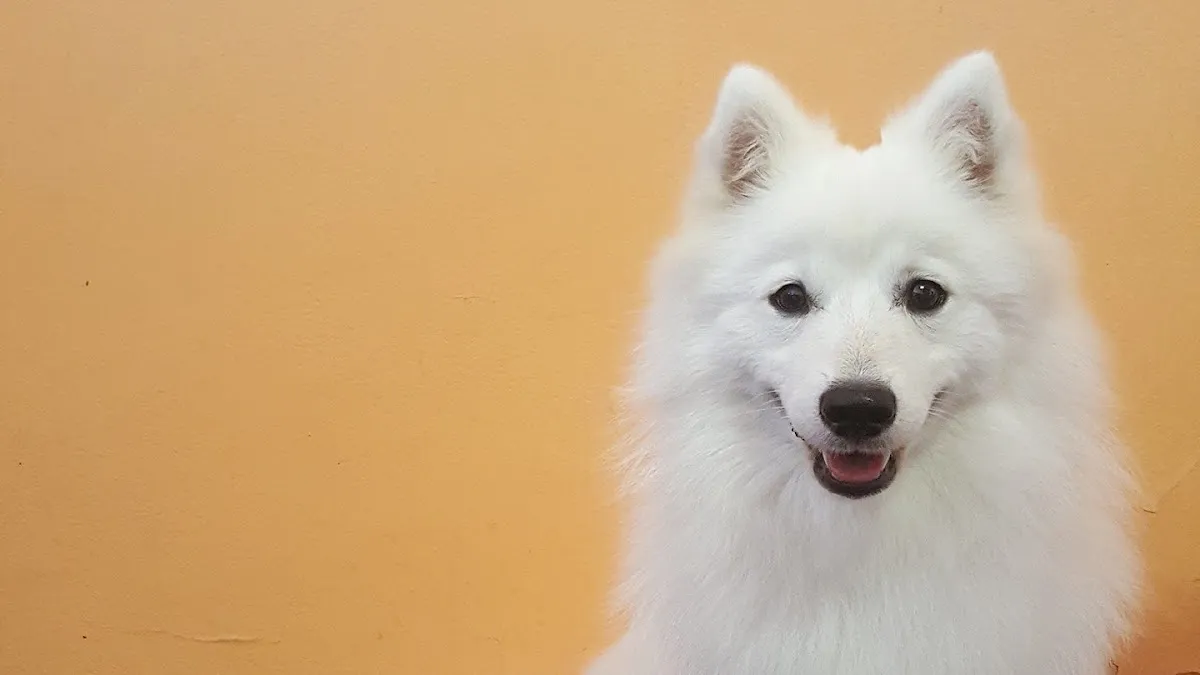 Photo: Spitz Groom, Carlton North VIC — via Groomably
The samoyed tidy — what a good groom actually includes
This is the groom most samoyed owners want and few know how to ask for. It leaves the body coat completely alone and shapes only the edges:
- Feet. Hair trimmed flush with the pads underneath, and the foot scissored round on top into the tidy “cat foot” the breed standard describes. This is the single most visible improvement on a samoyed, and the pad trim is a safety trim — pad hair collects grass seeds and makes hard floors slippery.
- Hocks. The feathering down the back of the hind legs scissored to a clean vertical line.
- Sanitary trim. Neatening around the rear and belly. On a white long-coated breed this is hygiene, not cosmetics.
- Ear edges and the fringe behind the ears. The number one matting site on the breed.
- Tail plume. Shaped to a tidy outline, never shortened.
Nothing on the back, sides, ruff or trousers is clipped. Ask for it in these words:
“A bath, full blow-out and de-shed, plus a tidy on feet, hocks and sanitary. No clipping on the body.”
That is an unambiguous instruction in any Australian salon and it is exactly what the well-groomed samoyeds in our library have had done.
The de-shed: what you are paying for
The samoyed de-shed follows the same sequence as any northern breed, and the dryer is the part that matters:
- Bath with a de-shedding shampoo and conditioner, chosen to hydrate and swell the undercoat so it releases rather than tears. On a samoyed this is usually also the whitening step.
- High-velocity dryer, driving air right down to the skin and pushing loose undercoat out in clouds. There is no home equivalent, and on a samoyed there is a second reason it is non-negotiable: a coat this dense that is left damp at the skin will develop hot spots.
- Undercoat rake, then slicker, collecting what the dryer released and reaching the hips, ruff and trousers.
- Steel comb through the furnishings — behind the ears, the britches, around the tail.
- The tidy, if you have asked for one.
Drying is the long pole on this breed. A samoyed holds an enormous amount of water and getting it genuinely dry to the skin takes real time, which is a large part of why the appointment costs what it does. Browse salons offering the service on our de-shedding page, or see samoyed de-shedding work specifically.
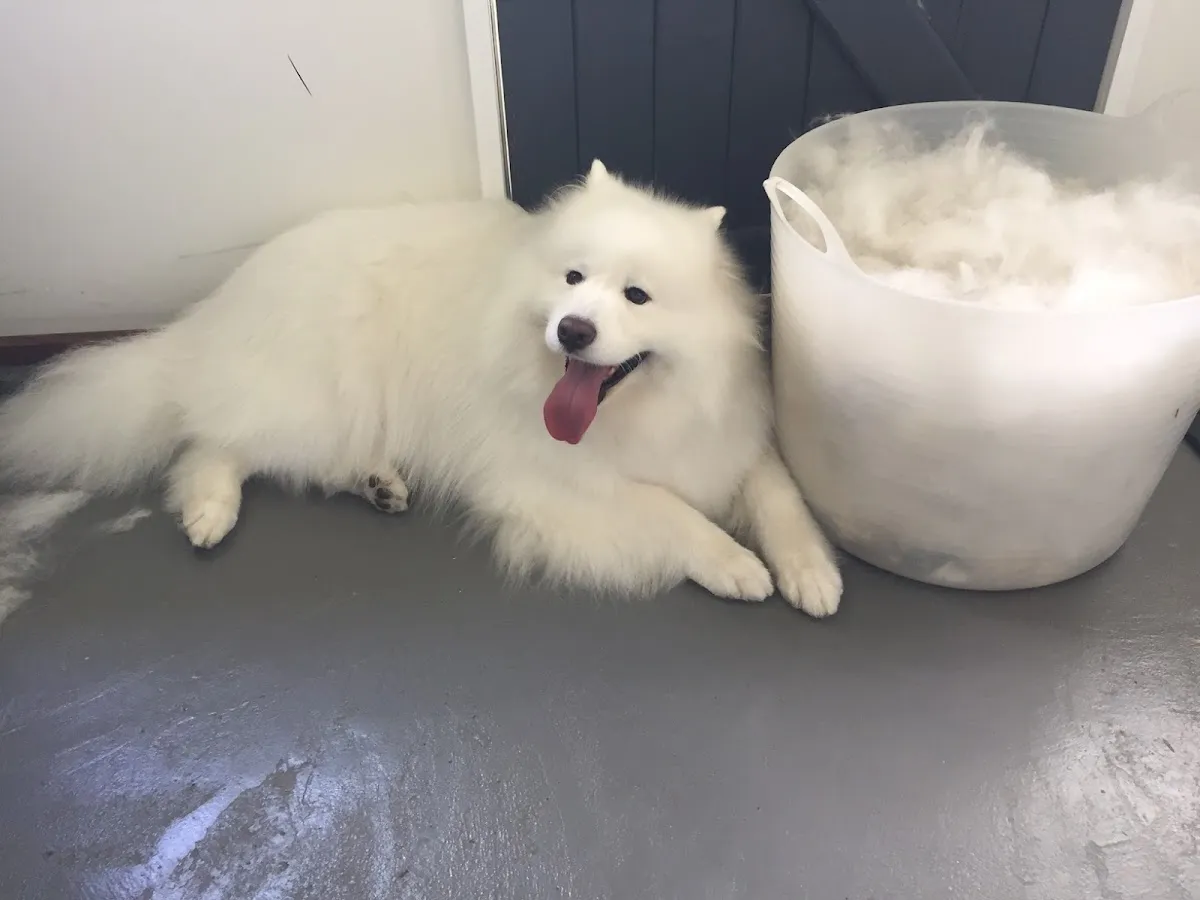 The bucket is a normal outcome of one samoyed appointment. Photo: Fluffy Puppies Dog Grooming Pty Ltd, Mont Albert North VIC — via Groomably
Should you shave a samoyed?
No — and the nine teddy bear cuts in our library are not the counter-argument they look like.
The case against shaving a samoyed is the standard double-coat case, and it is stronger here than on most breeds:
- It does not cool the dog. The insulating undercoat sits below any normal clipper guard and stays behind. What comes off is the guard coat, which was reflecting sun and holding a layer of still air.
- Samoyeds have pale skin under white coat. Sun exposure on a shaved samoyed is a real burn and long-term skin-damage risk in Australian conditions, and it is a worse risk on this breed than on a dark-skinned one.
- The regrowth is often permanently altered. Undercoat regrows faster than guard coat, so a shaved samoyed frequently grows back woolly, flat, grey-tinged and patchy. On plush white spitz coats this is a well-known and sometimes irreversible outcome — clipper alopecia. Most Australian groomers will decline the job for exactly this reason.
- It does not stop shedding. The undercoat is still there and still dropping, now as short prickly fragments that embed in fabric instead of sweepable tufts.
So what are the nine teddy bear cuts? Our classification tags what a photo looks like, not why it happened, and we are not going to pretend otherwise. In practice a scissored, shaped samoyed reads as a teddy bear cut to a classifier, and most of these are heavily tidied dogs rather than clipped ones. The remainder will be the genuine exceptions every groomer sees: matting past the point of dematting, medical or surgical need, and veterinary heat-management advice for a specific unwell or elderly dog. A pelted coat is a welfare problem and clipping it off is the humane answer, not a styling choice.
The honest framing is a trade-off with real and lasting costs, not an absolute prohibition. Our longer treatment is at should you shave a double-coated dog.
How often does a samoyed need grooming?
Professionally:
- Every 6–8 weeks is the realistic routine for a pet samoyed — noticeably tighter than the husky’s 8–12, because of the white coat and the furnishings.
- Twice a year without fail, timed to the spring and autumn coat blows, for a full de-shed. In Australia expect the big drop roughly September–November and a second, often smaller one March–May.
- Every 4–6 weeks for show dogs, dogs that swim or work, and any dog whose trousers are staining.
At home:
- Two to three times a week normally; daily during a coat blow.
- Work in sections, line brushing — lift a layer of coat, brush from the skin outwards, drop the next layer. Brushing over the top of a stand-off coat only tidies the surface and leaves the felting underneath untouched. This is the single most common samoyed grooming mistake.
- An undercoat rake for the body, a slicker for the furnishings, and a steel comb as the test. If a comb passes to the skin, you are done. If it stops, there is a mat there whatever the surface looks like.
- Never use a cutting de-shedding blade. It shears guard hairs along with undercoat and degrades the outer coat over time. A rake pulls loose undercoat without cutting anything.
- Check behind the ears every single week. It is where samoyed mats start, on almost every dog.
Nails every 4–6 weeks — see nail trimming.
Practical notes when booking
- Say the word samoyed when you enquire. A blown-coat samoyed is a long appointment and salons that see them regularly will price and slot it properly. Turning up mid-blow unannounced is how appointments run over.
- Ask about drying specifically. Getting a samoyed dry to the skin is the bulk of the labour, and it is the step a rushed groom skips.
- Do not leave it. A samoyed that has gone six months without a de-shed is not a longer version of the same appointment — it is a dematting job, and dematting is uncomfortable for the dog and expensive for you.
Cost is priced as a large-breed bath, de-shed and tidy rather than a haircut, and moves with how much coat is coming out. Our dog grooming cost guide covers how salons build the number.
Frequently asked questions
Do samoyeds shed a lot? Yes — steadily year-round and heavily twice a year. De-shedding appears on 49.0% of tagged samoyed photos in our library against a baseline of 8.5%, the second-highest rate of any breed we hold.
Can you shave a samoyed in summer? You should not. The undercoat that insulates stays behind under a normal clipper guard, the guard coat you remove was providing sun protection to pale skin, and the regrowth is frequently woolly and permanently altered. A proper de-shed genuinely improves airflow to the skin; a shave does not.
Why is my samoyed matting behind the ears? That fringe is fine, dense, and rubs constantly against the ear. It felts first on nearly every samoyed. Line brush it with a slicker and finish with a steel comb weekly — a slicker alone glides over the top of a forming mat.
Do samoyeds need haircuts? Not on the body. They need a tidy: feet, hocks, sanitary and ear edges scissored, with the body coat left alone. In our library about one samoyed in nine shows scissoring of some kind, which is mostly this tidy rather than a true clip.
How is samoyed grooming different from husky grooming? Same de-shedding need, different finishing. Huskies are washed and de-shed and essentially never touched with scissors (0.8% of our husky photos). Samoyeds get the same de-shed plus a scissored tidy, because the coat is longer, stands off, and is white enough to show everything.
Why does my samoyed look yellow? Grass, saliva, urine on the trousers and tear staining, in roughly that order. It is a bathing and trimming problem rather than a coat problem, and whitening shampoo plus keeping the sanitary and trouser areas trimmed handles most of it.
Find a samoyed groomer
Browse Australian salons with real samoyed work in their galleries on our samoyed page, see samoyed grooming photos, or search the full directory by suburb. Every photo above is a real Australian dog at a real salon, credited to the business that groomed it.


