
A puppy cut is the most requested haircut in dog grooming and the least standardised. Ask five salons what it means and you will get four answers: one even length all over, a short practical trim, whatever a puppy gets on its first visit, or simply “the cheap one”.
They are all defensible, which is exactly the problem. The name describes a look — the soft, uniform, slightly fluffy coat a puppy has before its adult coat comes through — not a measurement. So the useful version of this guide is not a definition. It is the vocabulary that gets you the coat length you actually pictured.
The working definition
Among Australian groomers, a puppy cut most commonly means: the whole dog taken to one even length with clippers or a comb attachment, including the legs, with the face trimmed neat and short to match.
That is it. One length, everywhere, no sculpting. The usual range is a #3F to #7F blade or comb — roughly 3 mm to 20 mm depending on the salon and the season.
Everything people argue about is downstream of one missing number: how long is “one length”? A puppy cut at 20 mm and a puppy cut at 3 mm are wildly different dogs, and both are correctly named.
The fix, and it takes one sentence: name a length or hold up your fingers. “A puppy cut, about this long — a #4 comb if that sounds right to you.” A groomer will happily correct your blade number; they cannot read your mind about length.
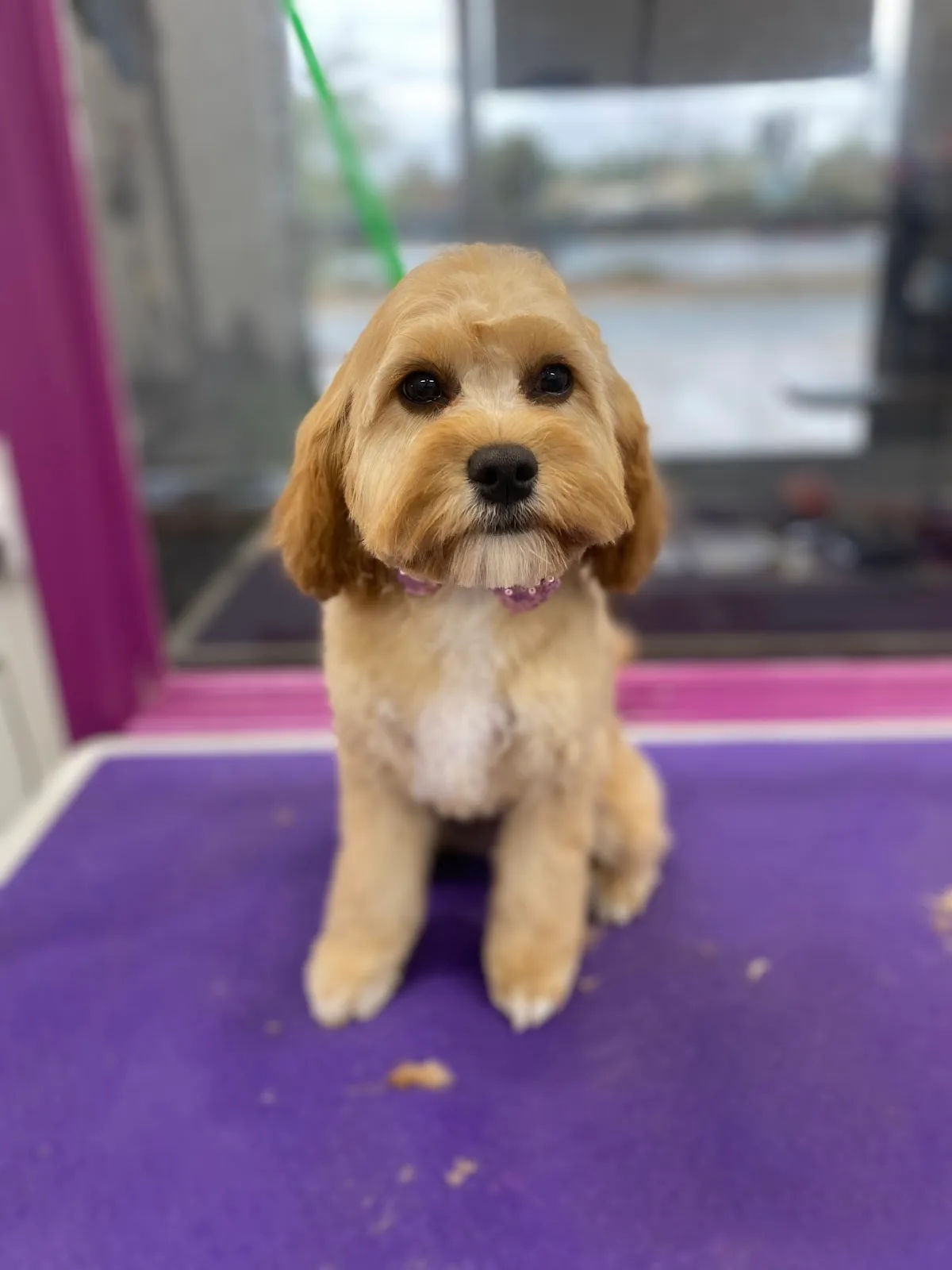 Photo: Scruff to Fluff Grooming & Pet Supplies, Kialla VIC — via Groomably
Puppy cut vs teddy bear cut vs kennel cut
These three names cover almost every “short but not shaved” request in a salon, and they genuinely differ:
| Body | Face | Legs | Typical cost | |
|---|---|---|---|---|
| Puppy cut | One even length | Trimmed short and neat | Same as body | Standard full-groom price |
| Teddy bear cut | One even length | Sculpted round, muzzle left full, no visible line | Same as body, scissor-finished | Slightly above |
| Kennel cut | Short — usually #7F or shorter | Short, practical | Same as body | Standard or below |
The teddy bear is a puppy cut with the face work added — and that face work is most of the labour, which is why it costs more. A kennel cut is a puppy cut taken shorter, historically the low-maintenance clip a dog got before a long boarding stay. See our teddy bear cut guide for the full treatment of that style.
Groomably’s puppy groom service pages cover the separate thing that shares the name — a first-visit introduction session for an actual puppy, which is about desensitisation rather than a haircut.
A note on the word “puppy”
Two completely different services share this name and it causes real confusion at booking:
- A puppy cut is a haircut style. It suits adult dogs of any age, and most dogs getting one are years past puppyhood.
- A puppy groom (or puppy introduction) is a short, gentle first session for a young dog: a bath, a blow-dry at low pressure, clippers run over the body switched on but barely cutting, feet handled, nails done, lots of stopping. The point is that the dog learns the salon is boring and safe. 532 of the 1,728 Australian salons in our directory list a dedicated puppy introduction service — nearly a third — and booking one at around 12–16 weeks does more for a lifetime of easy grooming than any product you can buy.
If you are booking for an actual puppy, ask for the introduction, not the cut. There is very little to cut at that age anyway.
Which breeds a puppy cut suits
The style needs a coat that grows continuously and doesn’t shed out. That points at the same list every time:
Excellent: poodle and every poodle cross (cavoodle, groodle, maltipoo, spoodle, labradoodle), shih tzu, maltese, bichon frise, havanese, yorkshire terrier, pomeranian with care.
Not suitable: double-coated breeds — labrador, golden retriever, german shepherd, husky, samoyed, border collie. Clipping these to one even length removes guard hairs that may regrow patchily or not at all, and it makes shedding worse rather than better. What these dogs want is a de-shedding treatment, which strips the dead undercoat and leaves the protective layer alone. Our guide on shaving a double-coated dog covers why in detail.
Pomeranians deserve their own warning. A puppy cut on a pom — often sold as a “teddy bear pom” — is a clip on a double coat, and post-clipping alopecia is common enough in the breed to have a name. A tidy-up on a pom is fine. One even length is a gamble with the coat.
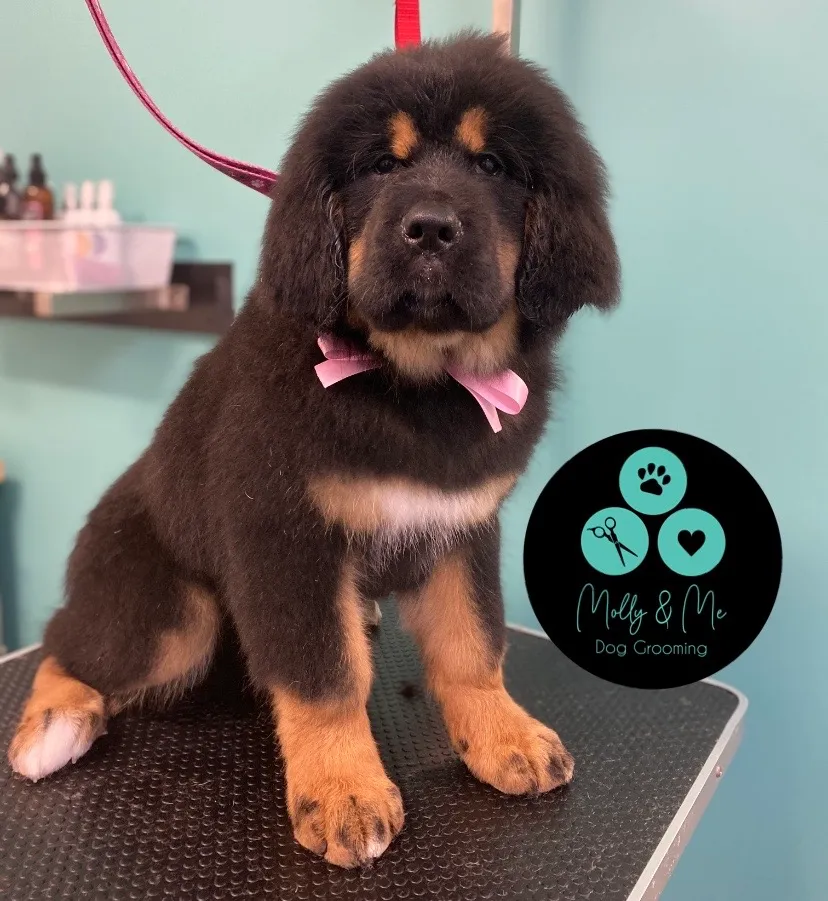 Photo: Molly & Me Dog Grooming, Vermont VIC — via Groomably
Picking your length
The number on the blade or comb is the whole decision. Rough guide:
- #7F (about 3 mm) — very short. Skin visible on pale dogs. Ten weeks or more between grooms. Sunburn risk in an Australian summer.
- #5F (about 6 mm) — short and practical. Eight to ten weeks. The most common “I want it low-maintenance” answer.
- #4F (about 13 mm) — the sweet spot for most owners. Still looks like a coat, still easy to brush, six to eight weeks.
- #3F (about 20 mm) — fluffy and photogenic, and the point at which your brushing obligations get real. Six weeks maximum.
- Longer than #3F — you are into scissor-finish territory, and daily line brushing.
Longer coat means more work at home, not less. That trips up almost everyone booking their first short cut: people take a length shorter than they wanted because they were told long is high-maintenance, then find they miss the coat. Take the length you like and commit to the brush.
What it costs
A puppy cut is priced as a standard full groom, because that is what it is. Across the salons in our directory that generally means $70–110 for a small dog, $90–130 for a medium and more for large or thick coats, with mobile services above salon pricing. There is no premium for the style itself — if anything it is at the lower end of full-groom pricing, because it is faster than a scissored or breed-standard finish.
The variable that actually moves the bill is coat condition. A matted coat adds time and, past a point, forces the groomer to clip shorter than you asked. That is the correct call: brushing out a tight mat is painful, and taking it off is the humane option. Our dog grooming cost guide has the full breakdown by size and state.
Making it last
- Brush from the skin out, in parted sections, then check with a metal comb. If the comb won’t reach the skin, the brush hasn’t done its job.
- Check the friction points weekly — behind the ears, armpits, under the collar, between the back legs. Mats start there first on every breed.
- Book the next appointment on the way out. Deciding when your dog “looks like it needs it” reliably means arriving two weeks past the point where the style was still recoverable.
- A face-and-feet tidy halfway through keeps hair out of the eyes and gets a groomer’s hands on the coat every three or four weeks instead of every eight.
Frequently asked questions
What exactly is a puppy cut on a dog? One even length over the entire body and legs, with the face trimmed short and neat. It is a look, not a fixed measurement — most salons cut it somewhere between 3 mm and 20 mm, so name the length you want.
Is a puppy cut the same as a teddy bear cut? No. Both take the body to one even length. A teddy bear cut adds sculpted, round face work with the muzzle left full and no visible scissor line, which takes longer and usually costs a little more.
How long does a puppy cut last? Six to ten weeks depending on the length. Shorter cuts last longer before they look untidy, but any coat left past about eight weeks starts matting at the friction points.
Can any dog get a puppy cut? No. It suits continuously growing single coats — poodles and their crosses, shih tzus, maltese, bichons, havanese, yorkies. Double-coated breeds should get a de-shedding treatment instead; clipping them to one length can permanently damage the coat.
What’s the difference between a puppy cut and a puppy groom? A puppy cut is a haircut style for a dog of any age. A puppy groom is a gentle first-visit introduction session for a young dog, designed to teach it that the salon is safe. If your dog is under about five months, book the introduction.
Browse real puppy cut photos from Australian salons, or find a dog groomer near you.


