
Groomably holds 79 bernedoodle photos from 72 Australian salons. It is a smaller set than our cavoodle or groodle libraries — bernedoodles are newer here — but it is spread across 72 different businesses, and what it shows is consistent enough to be worth publishing, because it contradicts the thing most people assume about doodles.
Here is the number that stopped us:
| Breed | Teddy bear cut (of tagged) | De-shedding (of tagged) |
|---|---|---|
| Maltipoo | 68.6% | 5.7% |
| Cavoodle | 55.7% | 2.2% |
| Groodle | 51.4% | 4.5% |
| Bernedoodle | 17.2% | 41.4% |
The bernedoodle is the doodle that gets de-shed instead of clipped. It happens at nineteen times the cavoodle rate and roughly nine times the groodle rate, while the teddy bear cut — the default doodle groom, and the most common groom in Australia at 38.6% of our whole library — happens on bernedoodles at less than a third of the cavoodle rate.
If you bought a bernedoodle expecting cavoodle grooming, this guide is the correction.
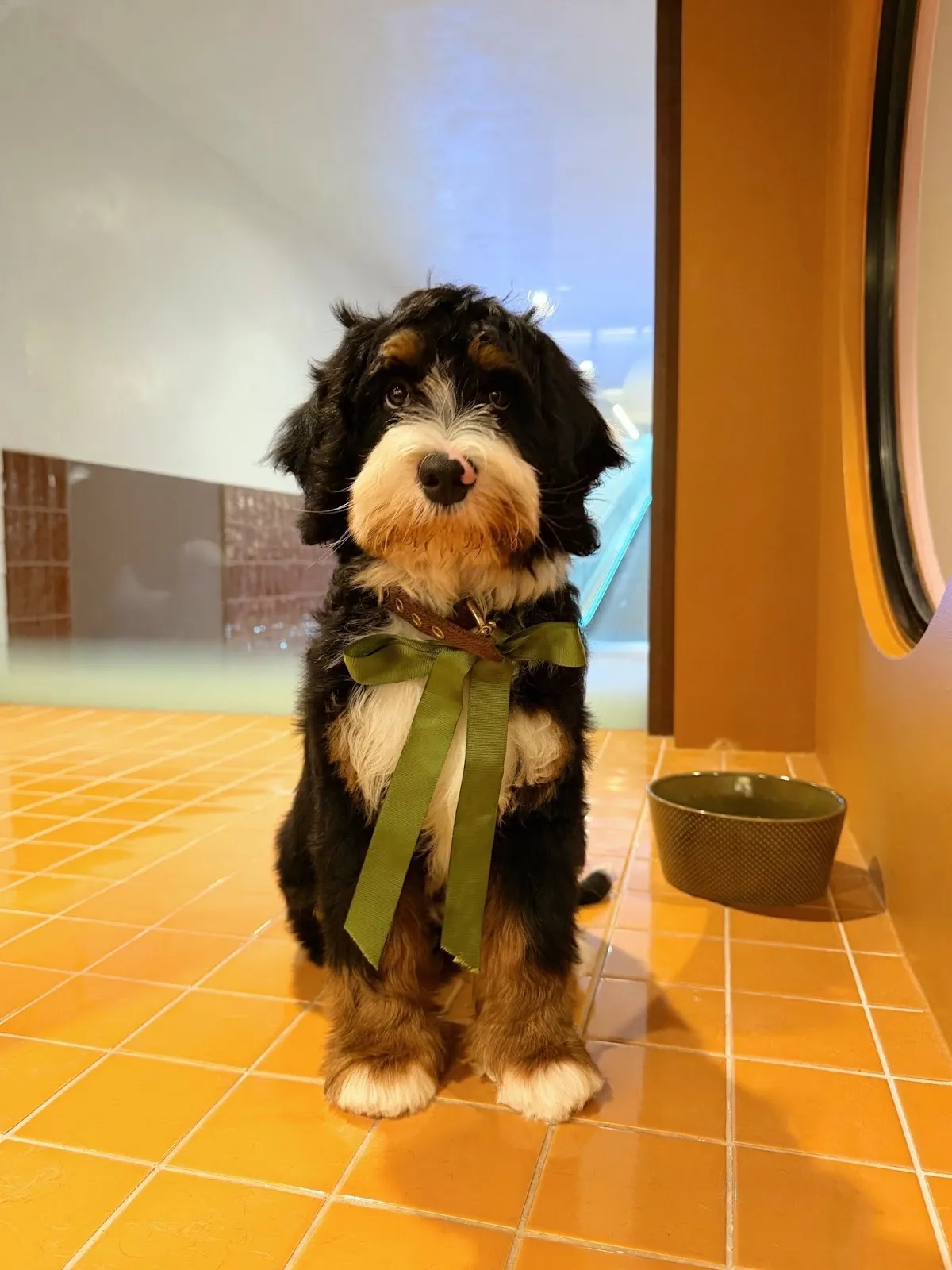 Photo: WOOOF Dog Grooming, Surry Hills NSW — via Groomably
The reason: the other half of the cross
A bernedoodle is a Bernese mountain dog crossed with a poodle. Everyone focuses on the poodle half. The Bernese half is what determines your grooming bill.
A poodle grows hair continuously, in a dense single coat that does not shed appreciably and must be cut. That is why poodle-dominant crosses live at the clippers: poodles in our library carry a clipped or styled cut in 51% of all photos.
A Bernese mountain dog has a long double coat — a silky outer layer over a woolly undercoat — and it sheds heavily, twice-yearly in bulk and steadily in between.
Cross them and the coat you get is a lottery, and it does not resolve until the puppy coat clears. Bernedoodle owners describe three broad outcomes, and our data is consistent with all three being common:
- Curly (poodle-dominant). Tight curl, minimal shedding, mats readily. Grooms like a poodle: clip every 6–8 weeks or accept dematting.
- Wavy (the most common). Loose wave, moderate shedding, and a genuine mix — needs both clipping and de-shedding.
- Straight / flat (Bernese-dominant). Often visibly double-coated, sheds properly, mats far less. Grooms much closer to a border collie than to a cavoodle.
F1 bernedoodles (first-generation, 50/50) throw the widest range. F1b bernedoodles (bred back to a poodle) skew curlier and lower-shedding. No bernedoodle is reliably hypoallergenic, and any breeder who promises one on an F1 is guessing.
The 41.4% de-shedding rate in our library is the trade quietly reporting that a large share of Australian bernedoodles landed in the wavy and straight camps.
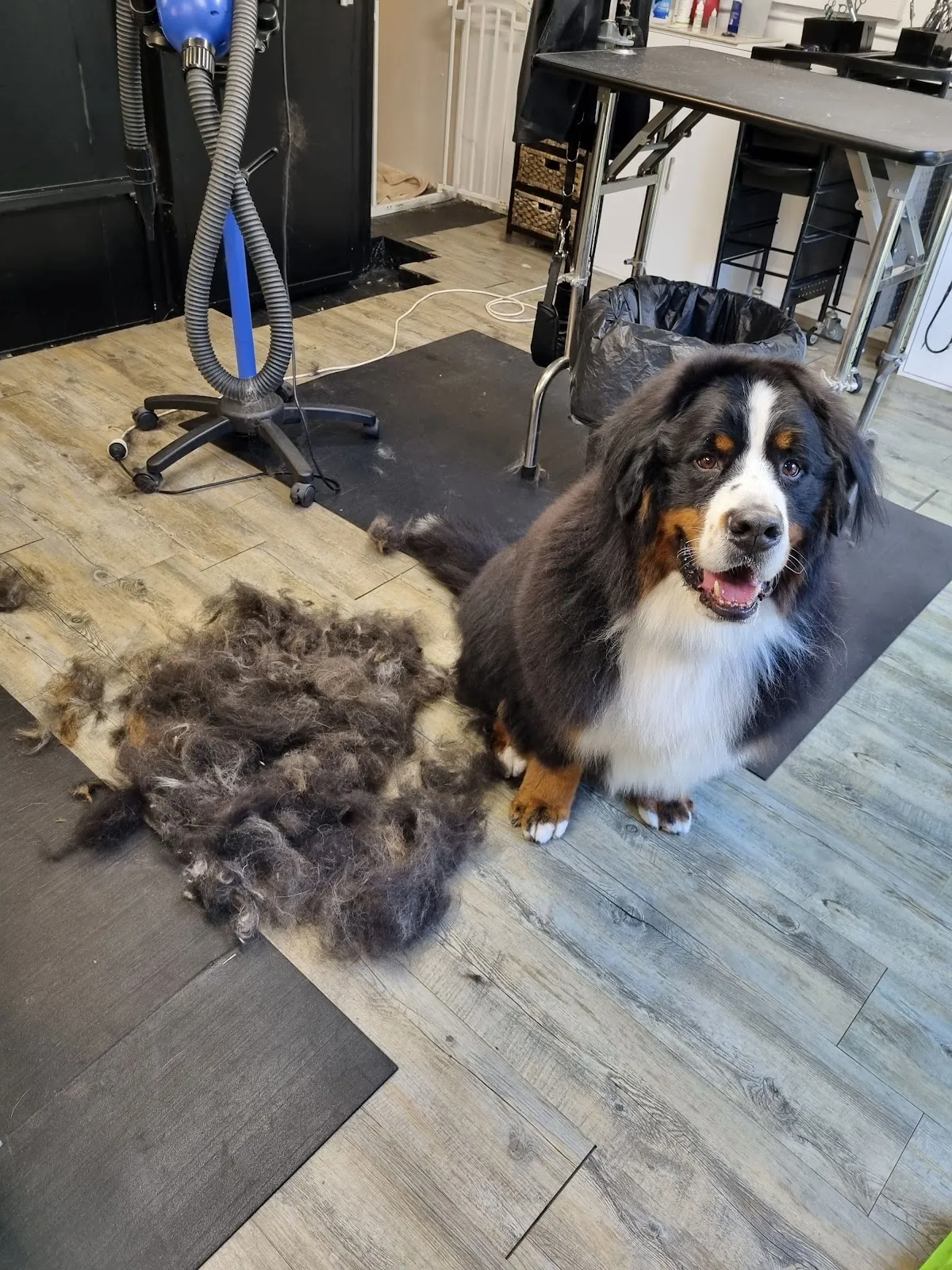 A bernedoodle mid-de-shed. Not a groom most doodle owners expect to be booking. Photo: Hownd Dog Grooming, Yangebup WA — via Groomably
What Australian salons actually do to a bernedoodle
Of the 29 style-tagged bernedoodle photos:
| Service | Photos | Share of tagged |
|---|---|---|
| De-shedding treatment | 12 | 41.4% |
| Bath and dry | 10 | 34.5% |
| Full groom | 7 | 24.1% |
| Teddy bear cut | 5 | 17.2% |
| Large-breed groom | 2 | 6.9% |
| Nail trimming | 1 | 3.4% |
| Puppy cut | 1 | 3.4% |
| Scissor cut | 1 | 3.4% |
Photos can carry more than one tag, so the column sums above 29. This is our smallest breed set of the three, and we would not lean on a 29-photo sample for a fine distinction — but a 41% versus 2% gap against the cavoodle is not a fine distinction.
The large-breed tag is the other thing worth noticing. A standard bernedoodle is a genuinely big dog — commonly 30–50kg — and size changes the appointment. It is longer, it needs a groomer with the equipment and the physical setup for a large dog, and it is priced accordingly. Mini and tiny bernedoodles (poodle-to-mini-poodle crosses) sidestep this entirely.
Which cut should a bernedoodle get?
Work from the coat, not from the photos you saved.
If the coat is curly
Treat it as a doodle. The realistic options:
- Teddy bear cut — the default. One length over the body (usually 20–40mm), face scissored round and full, legs left as columns. Warm, round, and the reason most people bought the dog. See our teddy bear cut guide.
- Puppy cut — shorter, one length everywhere including the face, no shaping. Lower maintenance and a good honest choice.
- Kennel cut / summer cut — shortest practical, 10–15mm, for owners who want 12 weeks between appointments instead of 6.
A curly bernedoodle is a large dog wearing a poodle coat. That is a lot of coat to brush, and matting on a 40kg dog is a far bigger job than matting on a 6kg cavoodle. Be realistic about the interval you will actually keep.
If the coat is wavy
This is the most common outcome and the one that needs both services. Ask for a de-shed and a trim, not one or the other. A wavy bernedoodle clipped short without de-shedding still drops undercoat everywhere; de-shed without a trim and the furnishings still mat.
A breed-specific tidy at a longer length — shaping the outline, tidying feet, hocks, sanitary and the face, taking the body down only modestly — usually suits this coat better than a short teddy bear.
If the coat is straight or flat
Do not clip it short by default. A visibly double-coated bernedoodle has the same trade-off as any double coat: undercoat regrows faster than guard coat, so repeated clipping can leave the coat woolly, dull and patchy, and it does not reduce shedding because the undercoat is still there. What this dog needs is a de-shed, a bath and a tidy. See should you shave a double-coated dog for the full argument.
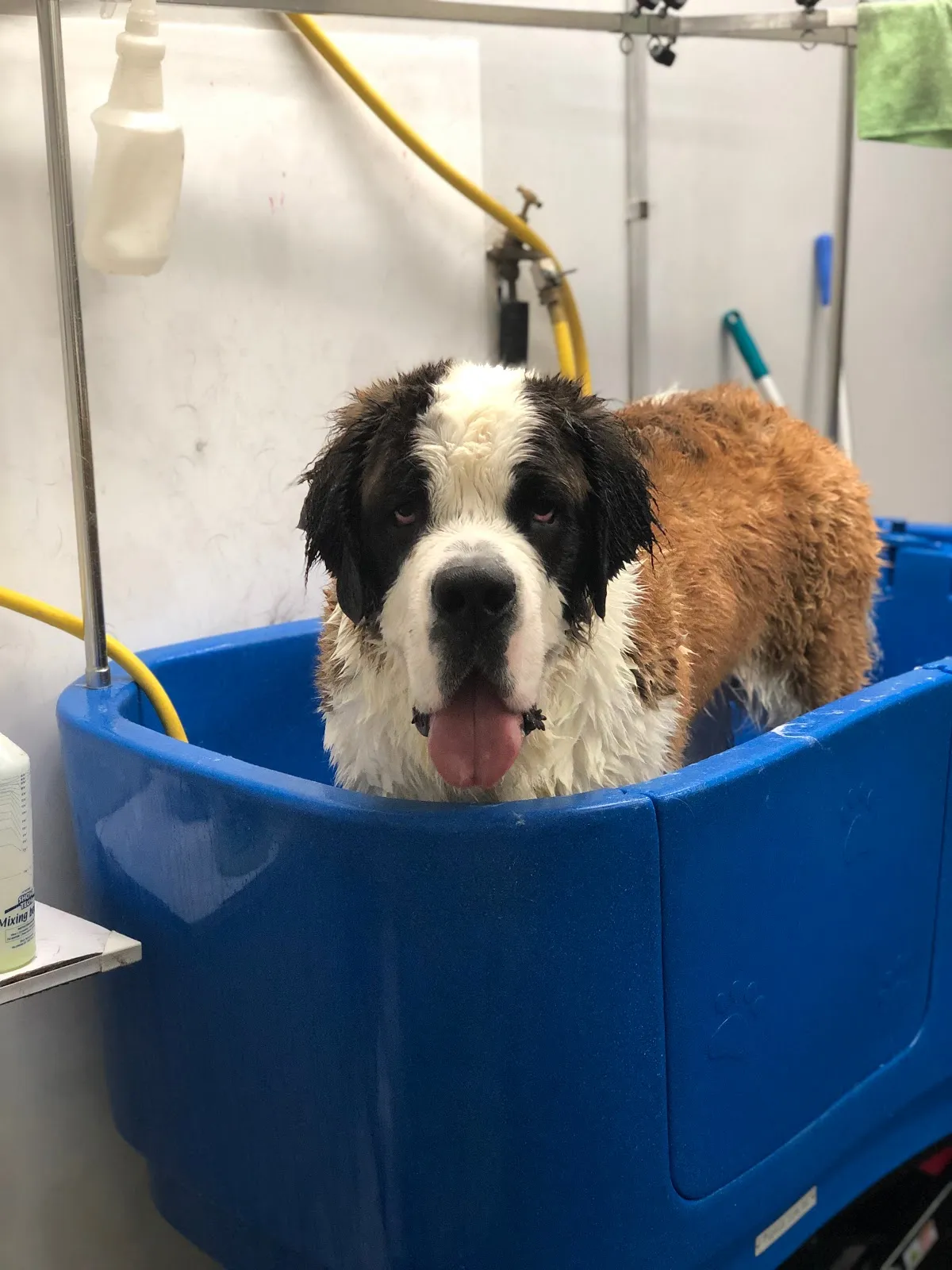 Photo: The Grooming Salon, Greenslopes QLD — via Groomably
How to tell which coat your bernedoodle has
Two tests, both free.
The comb test. Push a steel comb into the coat at the shoulder and try to reach the skin, then draw it out. If it snags on tight curl, you have a curly coat. If it passes but brings out a wad of soft woolly undercoat, you have a double coat and you need de-shedding. If it does both, you have a wavy coat and you need both services.
The parting test. Part the coat over the hip and look at the base. A single coat is one texture all the way to the skin. A double coat has a visibly different, softer, paler layer underneath the guard hairs.
Do this at about 8–10 months, when the puppy coat has cleared and the adult coat is showing what it will actually be. Before then you are reading the wrong coat.
The puppy coat change — do not miss it
Between roughly 8 and 14 months, a bernedoodle’s soft puppy coat is pushed out by the adult coat. During the changeover both coats are present at once, and the dead puppy coat felts against the incoming adult coat at the friction points: behind the ears, in the armpits, on the chest and around the collar.
This is when most doodles arrive at a salon pelted, and it is when the appointment stops being a haircut and becomes a shave-down. It is entirely avoidable:
- Comb daily through the coat change, to the skin, in sections.
- Book a salon appointment every 4–6 weeks through this window, even if the dog does not look like it needs one.
- Get the puppy used to the table, the dryer and having its feet and face handled well before it matters. A puppy’s first groom is about training, not haircuts.
How often, and what to ask for
Professionally:
- Curly coat: every 6–8 weeks. Non-negotiable if you want a haircut rather than a shave-down.
- Wavy coat: every 6–10 weeks, plus a proper de-shed at each seasonal drop.
- Straight / double coat: every 8–12 weeks, and twice a year without fail timed to the coat blows.
At home: comb to the skin two or three times a week on any coat type, daily during the puppy coat change and during a coat blow. Use a slicker for the furnishings, a steel comb as the test, and an undercoat rake if the comb test found undercoat. The comb is the tool that tells you the truth — a slicker skates over the top of a forming mat and leaves it there.
Nails every 4–6 weeks — see nail trimming.
What to say at the salon, once you know the coat:
- Curly: “A teddy bear cut, 25mm on the body, face and legs scissored.”
- Wavy: “A de-shed, then a tidy — outline, feet, hocks, sanitary and face. Keep the length.”
- Straight: “A bath, full blow-out and de-shed, plus a tidy. No clipping on the body.”
Two practical notes: say that the dog is a bernedoodle and give the weight when you enquire, because a 40kg doodle needs a longer slot and the right equipment; and do not stretch the interval to save money on a curly coat. The dematting fee, or the shave-down you did not want, costs more than the appointment you skipped. Our dog grooming cost guide covers how salons price by size, coat and condition.
Frequently asked questions
Do bernedoodles shed? Many of them do, and more than owners expect. In our library de-shedding appears on 41.4% of tagged bernedoodle photos, against 2.2% for cavoodles and 4.5% for groodles. How much your individual dog sheds depends on which parent’s coat it inherited, which is not settled until the adult coat comes in around 8–10 months.
Are bernedoodles hypoallergenic? No breed is, and bernedoodles are less reliably low-shedding than most doodles because the Bernese parent is a heavy-shedding double-coated breed. F1b bernedoodles (bred back to a poodle) skew curlier and lower-shedding than F1s, but it is a tendency, not a guarantee.
How often does a bernedoodle need grooming? Every 6–8 weeks for a curly coat, 6–10 for wavy, 8–12 for a straight double coat plus two seasonal de-sheds. Every coat type needs combing to the skin two or three times a week at home.
Can you shave a bernedoodle in summer? A curly, poodle-coated bernedoodle can safely be taken short — that is a normal doodle summer cut. A visibly double-coated one should not be, for the same reasons as any double coat: the insulating undercoat stays behind, the guard coat you remove was providing sun protection, the shedding does not stop, and the regrowth is often permanently altered.
Why is my bernedoodle matting so badly all of a sudden? Almost certainly the puppy coat change, somewhere between 8 and 14 months. The dead puppy coat felts against the incoming adult coat at the ears, armpits, chest and collar. Comb daily through this window and keep salon appointments tight.
Mini bernedoodle vs standard — does grooming differ? The coat rules are identical; the logistics are not. A standard bernedoodle at 30–50kg takes longer, needs a salon set up for large dogs, and is priced as a large-breed groom. Minis book like any medium doodle.
Find a bernedoodle groomer
Browse Australian salons with real doodle work in their galleries on our groodle, labradoodle and cavoodle pages, see the teddy bear cut and de-shedding galleries, or search the full directory by suburb. Every photo above is a real Australian dog at a real salon, credited to the business that groomed it.


