
Most golden retrievers don’t get a haircut at all. Of the 150 style-tagged golden retriever photos in Groomably’s classified library, 123 — 82% — show a bath-and-dry rather than any kind of cut. That’s the second-highest bath-and-dry share of any breed we track, behind only the labrador at 87%. Fourteen photos show a de-shedding treatment, fourteen show a full groom, and just eight show a teddy bear cut.
So when you search “golden retriever haircut”, the honest answer is that the thing most groomers do to a golden is wash it, blow the loose undercoat out of it, and neaten four or five specific areas with scissors. That’s the service. It’s called a tidy-up trim or a feathering trim, it costs less than a full clip, and it’s what makes the difference between a shaggy golden and a groomed one.
This guide covers that trim in detail, then the three cuts people ask for anyway — the summer cut, the puppy or kennel cut, and the teddy bear — and where each one sits between “fine” and “genuinely bad idea”.
The golden coat, and why it changes the whole question
A golden retriever has a double coat: a dense, soft, insulating undercoat beneath a longer, water-repellent outer coat of guard hairs. The two layers do different jobs. The undercoat traps air and regulates temperature in both directions. The guard hairs shed water, block UV and keep dirt off the skin.
Clippers can’t tell them apart. A clipper blade takes both layers down to the same length, and while the undercoat regrows quickly and thickly, the guard hairs are much slower — sometimes taking a year or more, sometimes never returning to their original texture. The result on a clipped golden is a coat that’s mostly fluffy undercoat with patchy guard hair through it, which sheds more, mats more easily and gives less sun protection than the coat you started with. Groomers call it coat funk or clipper alopecia, and it’s the reason a good groomer will push back gently when you ask to shave your golden for summer.
That single fact reorganises everything below. Our separate guide on whether you should shave a double-coated dog goes deeper on the biology; here we’re focused on what to actually book.
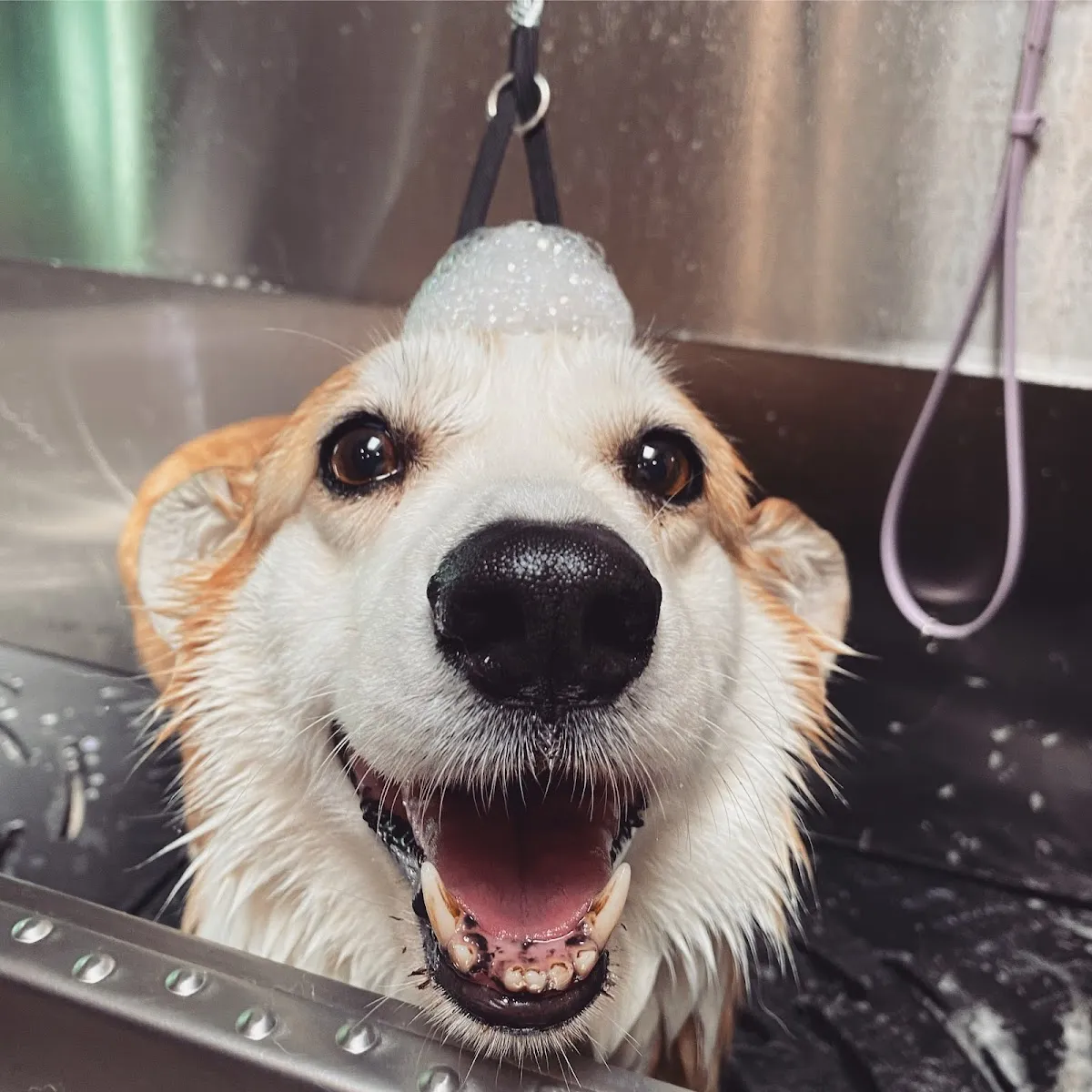 Photo: Adore Pet Grooming, Fyshwick ACT — via Groomably
1. The tidy-up trim (what “golden retriever haircut” usually means)
This is the standard golden groom, and the one 82% of the photos in our library are showing. Nothing is clipped short. Instead, the groomer scissors five areas where the coat grows long enough to look untidy or cause problems:
- Feet. Hair between the pads and around the edge of the foot is trimmed flush, which stops it collecting grass seeds, ice and mud, and gives the dog grip on floorboards. This alone transforms how a golden looks.
- Hocks. The back of the rear legs from hock to foot gets neatened into a clean line.
- Ears. The long feathering behind and under the ear is thinned and shortened. This is partly cosmetic and partly airflow — goldens are prone to ear infections.
- Tail. The plume is shaped into a tidy fan rather than left ragged.
- Sanitary area. A quick, discreet trim for hygiene.
Some groomers also lightly tidy the neck ruff and the chest feathering, but a good one won’t take much. The point of the trim is that a golden’s shape should still read as a golden when you’re done.
What to ask for: “A bath, full blow-dry and a tidy-up — feet, hocks, ears, tail and sanitary. Please don’t take anything off the body.” Say that last part explicitly if you’re at a new salon.
How often: Every six to ten weeks works for most goldens. Between visits, the feathering behind the ears and on the back legs is where matting starts, so that’s where the brush should go first.
You can see how a range of Australian salons handle it on the golden retriever breed page and the golden retriever bath-and-dry gallery.
2. De-shedding (the treatment that actually solves the hair problem)
Fourteen of our golden photos are tagged as de-shedding, and that number understates how often it’s added to a bath. If your complaint about your golden is hair — on the couch, in the car, woven into your clothes — this is the service that addresses it, not a haircut.
A de-shedding treatment is a bath with a releasing shampoo and conditioner, then a long, methodical high-velocity dry that physically blows dead undercoat out of the coat, followed by raking with an undercoat tool. A thorough one on a golden in full coat blow can fill a bin. Crucially, it removes the layer that’s causing the shedding while leaving the guard hairs — the ones that protect the skin — completely intact.
Goldens have two heavy shedding periods a year, typically spring and autumn in Australia, on top of a steady low-level shed year-round. Booking a de-shed at the front of each of those two windows is the single highest-value thing a golden owner can do. See what’s involved on the de-shedding service page or browse golden retriever de-shedding photos.
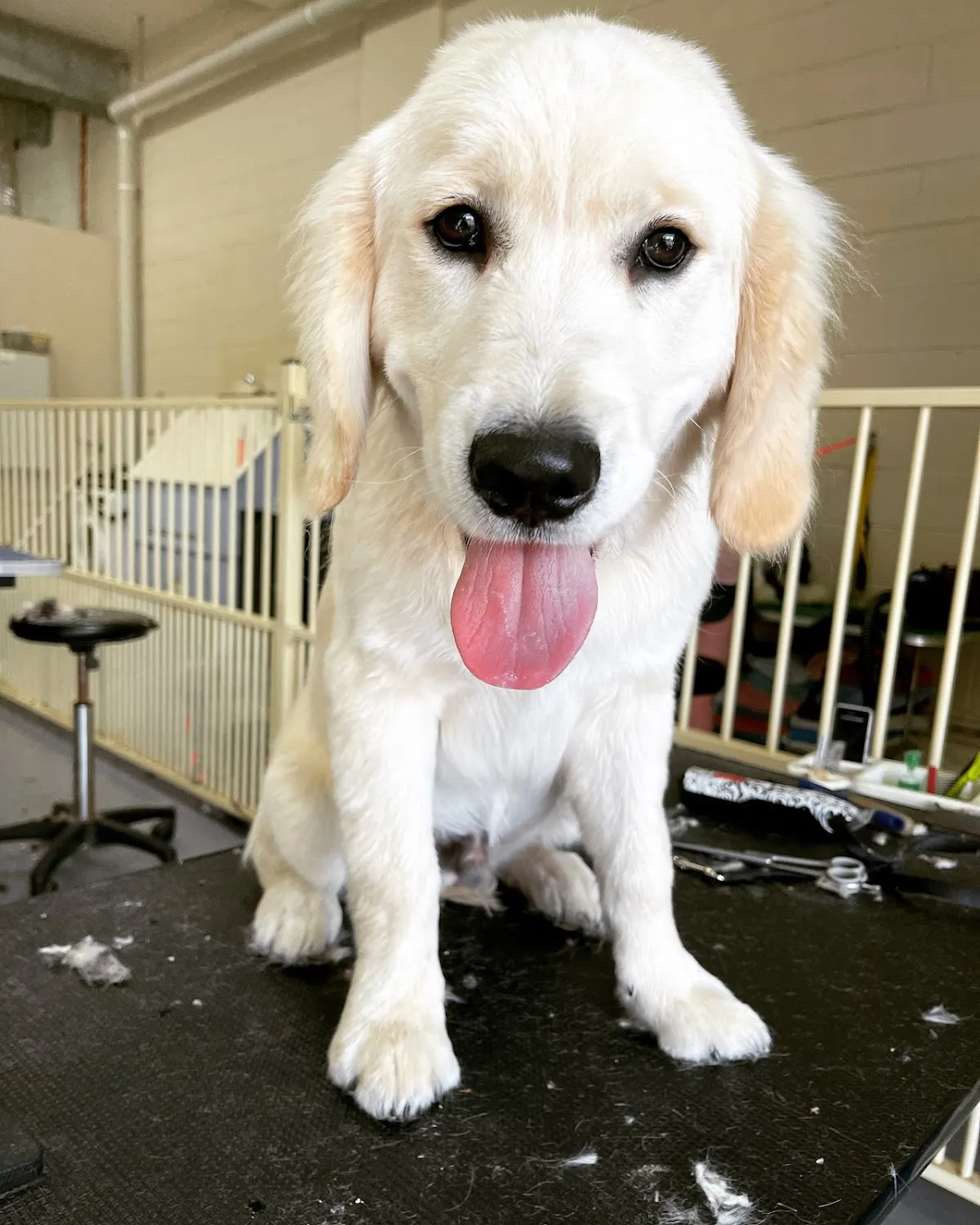 Photo: Dogs Only Grooming, Brookvale NSW — via Groomably
3. The summer cut (what really happens if you insist)
A “summer cut” on a golden isn’t a defined style — it’s whatever length the groomer takes the body down to, usually a #4 or #5 blade, leaving the head, ears and tail longer so the dog still looks like itself. Some salons will do it. Some will decline. Both are reasonable positions.
Here’s the honest version of the trade-off. A shaved golden does not get cooler. Dogs shed heat through panting and through their paw pads, not through the skin on their back, and the undercoat that traps warm air in winter also blocks radiant heat in summer. Remove it and you’ve removed insulation in both directions, plus the guard hairs that were blocking UV on a dog with pale, thin skin underneath. Sunburn on a clipped golden is a real vet presentation, not a scare story.
When a short clip is genuinely the right call: when the coat is matted to the skin and de-matting would be painful; when a medical condition or a surgery site needs clear access; when an elderly or mobility-limited dog can’t be brushed properly and hygiene is failing. In those cases, the coat has already lost the argument, and a clean, comfortable dog beats an intact coat every time. A good groomer will tell you which situation you’re in.
If you go ahead: ask for a #4 or longer, keep the head, ears and tail full, and accept that the regrowth may come in soft and patchy. Don’t book it as a routine annual thing.
4. The teddy bear cut and the puppy cut
Eight photos in our whole golden retriever set show a teddy bear cut, and that scarcity is the finding. The teddy bear — plush even body, rounded scissored face — is a style built for curly and wool coats. It’s why 73% of poodle grooms and 84% of bichon grooms in our data are teddy bears, and why almost no golden grooms are. A straight double coat scissored round doesn’t hold the shape; it goes fluffy for two weeks and then shaggy.
Where you do see it work is on golden retriever crosses, particularly goldendoodles, where the poodle side supplies the curl the style needs. If that’s the look you’re actually after, our goldendoodle haircuts guide covers the lamb, teddy bear and summer cuts properly, and the teddy bear cut guide explains the style across breeds.
The puppy cut — one short even length all over — carries all the same double-coat problems as the summer cut, because on a golden it is the summer cut with a friendlier name. The word “puppy” does a lot of work in salon vocabulary; ask what blade length they mean.
 Photo: Sandy Paws Canine Care Centre, Charlestown NSW — via Groomably
Quick comparison
| Style | What’s actually done | Coat risk | How often | Best for |
|---|---|---|---|---|
| Tidy-up trim | Feet, hocks, ears, tail, sanitary | None | 6–10 weeks | Almost every golden |
| De-shedding treatment | Bath + long dry + undercoat rake | None | 2–4x/year, heavier in shed season | Hair-on-everything households |
| Summer / kennel cut | Body clipped to #4–#5 | High — guard hairs may not return | Not routine | Severe matting, medical need |
| Teddy bear cut | Scissored round, plush body | High, and it won’t hold | Rare on goldens | Goldendoodles, not goldens |
Brushing between grooms
The parts of a golden that mat are predictable: behind the ears, the ruff at the front of the chest, the feathering on the back of the front legs, the trousers on the rear legs, and the tail plume. The body coat rarely mats.
Twenty minutes with a slicker brush and a metal comb, twice a week, targeted at those five places, prevents almost every de-matting bill a golden owner ever gets. Comb rather than brush as the final check — a slicker glides over a mat that a comb catches immediately. During a coat blow, add an undercoat rake and do it outside.
Cost and frequency
A golden is a big dog with a lot of coat, so it sits at the upper end of most price lists even though no haircut is involved — the drying time is what you’re paying for. Our dog grooming cost guide has current Australian price bands by service and size, and how often you should groom your dog covers scheduling for double coats specifically.
The short version
The golden retriever’s coat is the finished product, not the raw material. The best grooming you can buy for one is a proper wash, a long blow-dry that gets the dead undercoat out, and scissors on five small areas. That’s what 82% of the goldens in our photo library are getting, and it’s the right answer for almost every dog.
If the shedding is the problem, book a de-shed rather than a clip. If matting has already won, take the short cut without guilt and grow it back. And if what you really want is a plush, round, teddy-bear dog, that’s a coat type, not a haircut — no clipper will produce one from a golden retriever.
When you’re ready, browse the golden retriever breed page to see real work from salons near you, or search the grooming directory and send an enquiry to a groomer whose double-coat work you like.


